Ch 08: Dynamics II: Motion in a Plane
Knight Calc - Physics for Scientists and Engineers 5th Edition
Knight Calc5th EditionPhysics for Scientists and EngineersISBN: 9780137344796Not the one you use?Change textbook
Chapter 8, Problem 27

A new car is tested on a 200-m-diameter track. If the car speeds up at a steady 1.5 m/s2, how long after starting is the magnitude of its centripetal acceleration equal to the tangential acceleration?

Verified step by step guidance
1
Step 1: Understand the relationship between centripetal acceleration and tangential acceleration. Centripetal acceleration is given by the formula \( a_c = \frac{v^2}{r} \), where \( v \) is the velocity and \( r \) is the radius of the circular path. Tangential acceleration is \( a_t = 1.5 \, \text{m/s}^2 \) (given in the problem). The condition for equality is \( a_c = a_t \).
Step 2: Substitute \( a_t \) and \( a_c \) into the equality condition. Using \( a_c = \frac{v^2}{r} \), set \( \frac{v^2}{r} = a_t \). The radius \( r \) of the track is half the diameter, so \( r = \frac{200}{2} = 100 \, \text{m} \). The equation becomes \( \frac{v^2}{100} = 1.5 \).
Step 3: Solve for \( v \) (velocity) in terms of the given tangential acceleration. Rearrange the equation \( \frac{v^2}{100} = 1.5 \) to \( v^2 = 1.5 \times 100 \). Then take the square root to find \( v \).
Step 4: Relate the velocity \( v \) to the time \( t \) using the formula for tangential acceleration. Since \( a_t = \frac{\Delta v}{\Delta t} \), and the car starts from rest, \( v = a_t \cdot t \). Substitute \( v \) from Step 3 into this equation to solve for \( t \).
Step 5: Perform the substitution and simplify. Replace \( v \) with \( \sqrt{1.5 \times 100} \) and \( a_t \) with \( 1.5 \) in the equation \( t = \frac{v}{a_t} \). This will give the time \( t \) when the centripetal acceleration equals the tangential acceleration.

Verified video answer for a similar problem:

This video solution was recommended by our tutors as helpful for the problem above.
Video duration:
3m
Was this helpful?

Key Concepts

Here are the essential concepts you must grasp in order to answer the question correctly.

Centripetal Acceleration

Centripetal acceleration is the acceleration directed towards the center of a circular path that keeps an object moving in that path. It is calculated using the formula a_c = v^2 / r, where v is the tangential speed and r is the radius of the circular path. In this scenario, as the car speeds up, its tangential speed increases, affecting the centripetal acceleration.
Recommended video:
Guided course
06:48
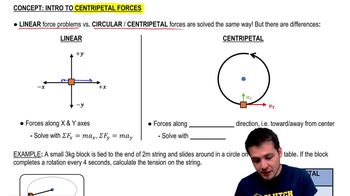
Intro to Centripetal Forces

Tangential Acceleration

Tangential acceleration refers to the rate of change of the speed of an object moving along a circular path. It is constant in this case, given as 1.5 m/s², and is responsible for increasing the car's speed as it moves around the track. This acceleration acts along the direction of the car's velocity, contributing to its overall motion.
Recommended video:
Guided course
08:17
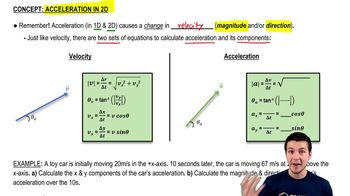
Acceleration in 2D

Equating Accelerations

To find the time when centripetal acceleration equals tangential acceleration, we set the two expressions equal to each other. This involves using the formulas for both types of acceleration and solving for the time variable. The relationship between the car's speed, radius, and the given tangential acceleration is crucial for determining when these two accelerations are equal.
Recommended video:
Guided course
08:17
Acceleration in 2D
Related Practice
Textbook Question

A toy train rolls around a horizontal 1.0-m-diameter track. The coefficient of rolling friction is 0.10. How long does it take the train to stop if it's released with an angular speed of 30 rpm?

1
views

Textbook Question

You are driving your 1800 kg car at 25 m/s over a circular hill that has a radius of 150 m. A deer running across the road causes you to hit the brakes hard while right at the summit of the hill, and you start to skid. The coefficient of kinetic friction between your tires and the road is 0.75. What is the magnitude of your acceleration as you begin to slow?

2
views
Textbook Question

A 500 g ball moves in a vertical circle on a 102-cm-long string. If the speed at the top is 4.0 m/s, then the speed at the bottom will be 7.5 m/s. (You'll learn how to show this in Chapter 10.) What is the tension in the string when the ball is at the top?

1
views
Textbook Question

A 500 g ball moves in a vertical circle on a 102-cm-long string. If the speed at the top is 4.0 m/s, then the speed at the bottom will be 7.5 m/s. (You'll learn how to show this in Chapter 10.) What is the gravitational force acting on the ball?

1
views
Textbook Question

A heavy ball with a weight of 100 N (m = 10.2 kg) is hung from the ceiling of a lecture hall on a 4.5-m-long rope. The ball is pulled to one side and released to swing as a pendulum, reaching a speed of 5.5 m/s as it passes through the lowest point. What is the tension in the rope at that point?

Textbook Question

An 85,000 kg stunt plane performs a loop-the-loop, flying in a 260-m-diameter vertical circle. At the point where the plane is flying straight down, its speed is 55 m/s and it is speeding up at a rate of 12 m/s per second. What angle does the net force make with the horizontal? Let an angle above horizontal be positive and an angle below horizontal be negative.

2
views