Ch 08: Dynamics II: Motion in a Plane
Knight Calc - Physics for Scientists and Engineers 5th Edition
Knight Calc5th EditionPhysics for Scientists and EngineersISBN: 9780137344796Not the one you use?Change textbook
Chapter 8, Problem 24b

A 500 g ball moves in a vertical circle on a 102-cm-long string. If the speed at the top is 4.0 m/s, then the speed at the bottom will be 7.5 m/s. (You'll learn how to show this in Chapter 10.) What is the tension in the string when the ball is at the top?

Verified step by step guidance
1
Step 1: Identify the forces acting on the ball at the top of the vertical circle. These include the gravitational force \( F_g = m g \) (where \( m \) is the mass of the ball and \( g \) is the acceleration due to gravity) and the tension in the string \( T_{top} \). Both forces act downward at the top of the circle.
Step 2: Use Newton's second law for circular motion at the top of the circle. The net force provides the centripetal force required to keep the ball moving in a circular path. The equation is \( F_{net} = T_{top} + F_g = \frac{m v_{top}^2}{r} \), where \( v_{top} \) is the speed at the top and \( r \) is the radius of the circle.
Step 3: Calculate the radius of the circle. The radius \( r \) is the length of the string, which is given as 102 cm. Convert this to meters: \( r = 1.02 \, \text{m} \).
Step 4: Substitute the known values into the equation from Step 2. The mass \( m \) is 500 g (convert to kilograms: \( m = 0.500 \, \text{kg} \)), \( g = 9.8 \, \text{m/s}^2 \), \( v_{top} = 4.0 \, \text{m/s} \), and \( r = 1.02 \, \text{m} \). The equation becomes \( T_{top} + (0.500)(9.8) = \frac{(0.500)(4.0)^2}{1.02} \).
Step 5: Rearrange the equation to solve for the tension \( T_{top} \). Isolate \( T_{top} \) by subtracting the gravitational force \( F_g = m g \) from both sides: \( T_{top} = \frac{m v_{top}^2}{r} - m g \). Substitute the values to find the tension at the top of the circle.

Verified video answer for a similar problem:

This video solution was recommended by our tutors as helpful for the problem above.
Video duration:
6m
Was this helpful?

Key Concepts

Here are the essential concepts you must grasp in order to answer the question correctly.

Centripetal Force

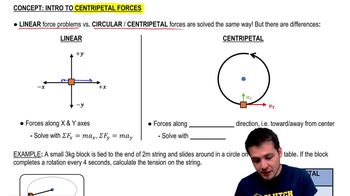
Centripetal force is the net force acting on an object moving in a circular path, directed towards the center of the circle. It is essential for maintaining circular motion and is calculated using the formula F_c = m*v^2/r, where m is mass, v is velocity, and r is the radius of the circle. In this scenario, the tension in the string and the gravitational force both contribute to the centripetal force when the ball is at the top of the circle.
Recommended video:
Guided course
06:48
Intro to Centripetal Forces

Gravitational Force

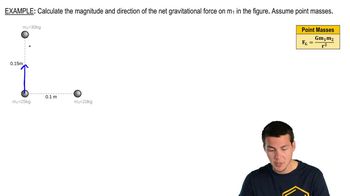
Gravitational force is the attractive force between two masses, calculated using Newton's law of universal gravitation. For an object near the Earth's surface, this force can be simplified to F_g = m*g, where m is the mass of the object and g is the acceleration due to gravity (approximately 9.81 m/s²). At the top of the vertical circle, this force acts downward and affects the net force required for circular motion.
Recommended video:
Guided course
05:41
Gravitational Forces in 2D

Tension in a String

Tension is the force transmitted through a string, rope, or cable when it is pulled tight by forces acting from opposite ends. In the context of circular motion, the tension in the string must counteract the gravitational force and provide the necessary centripetal force to keep the ball moving in a circle. At the top of the circle, the tension is calculated by balancing the forces acting on the ball, considering both the gravitational force and the required centripetal force.
Recommended video:
Guided course
04:39
Energy & Power of Waves on Strings