
Consider the system shown in Fig. 4–68 with mA = 8.2kg and mB = 11.5kg. The angles θA = 59° and θB = 32°. In the absence of friction, what force would be required to pull the masses at a constant velocity up the fixed inclines?
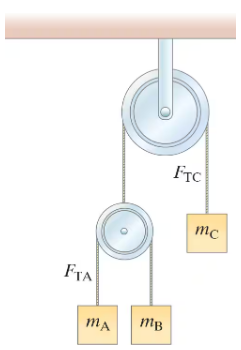
The double Atwood machine shown in Fig. 4–55 has frictionless, massless pulleys and cords. Determine the tensions FTA and FTC in the cords.

Verified step by step guidanceKey Concepts
Tension in Cords
Newton's Second Law
Equilibrium Conditions
Consider the system shown in Fig. 4–68 with mA = 8.2kg and mB = 11.5kg. The angles θA = 59° and θB = 32°. In the absence of , what is the tension in the string?
Determine a formula for the acceleration of the system shown in Fig. 4–49 (see Problem 55) if the cord has a non-negligible mass mC. Specify in terms of ℓA and ℓB , the lengths of cord from the respective masses to the pulley. (The total cord length is ℓA + ℓB.)
The double Atwood machine shown in Fig. 4–55 has frictionless, massless pulleys and cords. Determine the acceleration of masses mA, mB, and mC.
Three mountain climbers who are roped together in a line are ascending an icefield inclined at 29° to the horizontal (Fig. 4–67). The last climber slips, pulling the second climber off his feet. The first climber is able to hold them both. If each climber has a mass of 75 kg, calculate the tension in each of the two sections of rope between the three climbers. Ignore friction between the ice and the fallen climbers.
<IMAGE>
As shown in Fig. 4–48, five balls (masses 2.00, 2.05, 2.10, 2.15, 2.20 kg) hang from a crossbar. Each mass is supported by '5-lb test' fishing line which will break when its tension force exceeds 22.2 N (5.00lb). When this device is placed in an elevator, which accelerates upward, only the lines attached to the 2.05 and 2.00 kg masses do not break. Within what range is the elevator's acceleration?
