
Ch. 10 - Rotational Motion
Giancoli Douglas - Physics for Scientists and Engineers 5th edition
Giancoli Douglas5th editionPhysics for Scientists and EngineersISBN: 9780137488179Not the one you use?Change textbook
Chapter 10, Problem 3

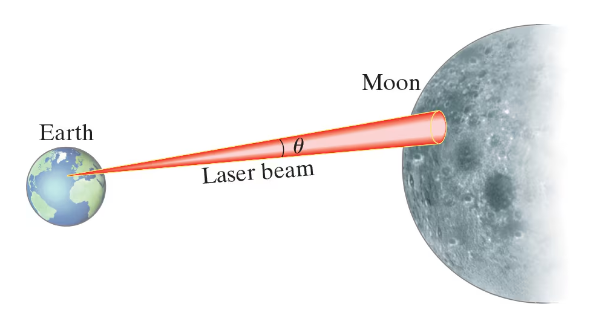
(I) A laser beam is directed at the Moon, 380,000 km from Earth. The beam diverges at an angle θ (Fig. 10–50) of 1.4 x 10⁻⁵ rad. What diameter spot will it make on the Moon?

Verified step by step guidance
1
Understand the problem: The laser beam diverges as it travels, forming a cone shape. The diameter of the spot on the Moon corresponds to the base of this cone. The relationship between the divergence angle (θ), the distance to the Moon (L), and the diameter of the spot (D) can be derived using geometry.
Recall the formula for the diameter of the spot: The diameter of the spot is given by \( D = 2 \cdot L \cdot \tan(\frac{\theta}{2}) \), where \( L \) is the distance to the Moon and \( \theta \) is the divergence angle.
Substitute the given values into the formula: \( L = 380,000 \, \text{km} = 3.8 \times 10^8 \, \text{m} \) and \( \theta = 1.4 \times 10^{-5} \, \text{rad} \).
Simplify the expression for \( \tan(\frac{\theta}{2}) \): Since \( \theta \) is very small, you can use the small-angle approximation \( \tan(x) \approx x \) for \( x \) in radians. Thus, \( \tan(\frac{\theta}{2}) \approx \frac{\theta}{2} \).
Calculate the diameter \( D \): Substitute \( \tan(\frac{\theta}{2}) \approx \frac{\theta}{2} \) into the formula \( D = 2 \cdot L \cdot \tan(\frac{\theta}{2}) \), which simplifies to \( D = L \cdot \theta \). Use this to find the diameter of the spot on the Moon.

Verified video answer for a similar problem:

This video solution was recommended by our tutors as helpful for the problem above.
Video duration:
4m
Was this helpful?

Key Concepts

Here are the essential concepts you must grasp in order to answer the question correctly.

Divergence of Laser Beams

Divergence refers to the spreading of a laser beam as it travels through space. It is typically measured in radians and indicates how much the beam expands over a distance. A smaller divergence angle results in a more focused beam, while a larger angle leads to a wider spot at a given distance.
Recommended video:
Guided course
13:40
Beam supporting an object

Calculating Spot Diameter

To find the diameter of the spot created by a laser beam on a distant surface, one can use the formula: diameter = 2 * distance * tan(θ/2). Here, θ is the divergence angle, and the distance is the distance to the target (in this case, the Moon). This calculation helps determine how much the beam spreads by the time it reaches the target.
Recommended video:
Guided course
04:15
Calculating Dot Product Using Vector Components

Units of Measurement

Understanding units of measurement is crucial in physics problems. Distances may be given in kilometers, while angles are often in radians. Converting these units appropriately ensures accurate calculations, especially when applying formulas that involve both distance and angle, as seen in the context of laser beam divergence.
Recommended video:
Guided course
07:46
Unit Conversions