(I) A laser beam is directed at the Moon, 380,000 km from Earth. The beam diverges at an angle θ (Fig. 10–50) of 1.4 x 10⁻⁵ rad. What diameter spot will it make on the Moon?
Ch. 10 - Rotational Motion
Giancoli Douglas5th editionPhysics for Scientists and EngineersISBN: 9780137488179Not the one you use?Change textbook
Chapter 10, Problem 5a
The platter of the hard drive of a computer rotates at 7200 rpm (rpm = revolutions per minute = rev/min). What is the angular velocity (rad/s) of the platter?
Verified step by step guidance1
Convert the given rotational speed from revolutions per minute (rpm) to revolutions per second (rps). Use the relationship: 1 minute = 60 seconds. The formula is: \( \text{rps} = \frac{\text{rpm}}{60} \).
Recognize that one revolution corresponds to an angular displacement of \( 2\pi \) radians. To find the angular velocity in radians per second (rad/s), multiply the revolutions per second (rps) by \( 2\pi \). The formula is: \( \omega = \text{rps} \times 2\pi \).
Substitute the value of \( \text{rps} \) from step 1 into the formula from step 2 to calculate \( \omega \), the angular velocity in rad/s.
Simplify the expression to express \( \omega \) in terms of \( \pi \) for clarity, if needed.
Ensure the units are consistent throughout the calculation and confirm that the final angular velocity is expressed in radians per second (rad/s).

Verified video answer for a similar problem:
This video solution was recommended by our tutors as helpful for the problem above.
Was this helpful?
Key Concepts
Here are the essential concepts you must grasp in order to answer the question correctly.
Angular Velocity
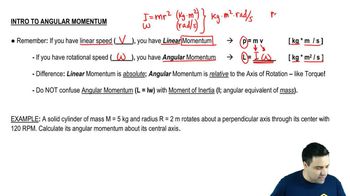
Angular velocity is a measure of how quickly an object rotates around an axis, expressed in radians per second (rad/s). It quantifies the rate of change of angular displacement and is crucial for understanding rotational motion. The formula to convert from revolutions per minute (rpm) to radians per second is: angular velocity (ω) = (rpm × 2π) / 60.
Recommended video:
Guided course
Intro to Angular Momentum
Revolutions and Radians
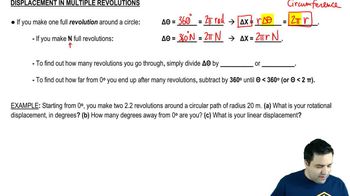
A revolution refers to a complete turn around a circle, which corresponds to an angular displacement of 2π radians. Understanding the relationship between revolutions and radians is essential for converting angular measurements. This conversion is necessary when calculating angular velocity from rpm, as it allows for a consistent unit of measurement in physics.
Recommended video:
Guided course
Displacement in Multiple Revolutions
Unit Conversion
Unit conversion is the process of converting a quantity expressed in one set of units to another. In this context, converting rpm to rad/s involves understanding the relationship between the units and applying appropriate conversion factors. Mastery of unit conversion is vital in physics to ensure that calculations are accurate and meaningful across different contexts.
Recommended video:
Guided course
Unit Conversions
Related Practice
Textbook Question
2
views
Textbook Question
A child rolls a ball on a level floor 3.1 m to another child. If the ball makes 12.0 revolutions, what is its diameter?
3
views
Textbook Question
The platter of the hard drive of a computer rotates at 7200 rpm (rpm = revolutions per minute = rev/min). If a single bit requires 0.50 μm of length along the direction of motion, how many bits per second can the writing head write when it is 3.00 cm from the axis?
2
views
Textbook Question
The platter of the hard drive of a computer rotates at 7200 rpm (rpm = revolutions per minute = rev/min). If the reading head of the drive is located 3.00 cm from the rotation axis, what is the linear speed of the point on the platter just below it?
1
views