Ch. 10 - Rotational Motion
Giancoli Douglas - Physics for Scientists and Engineers 5th edition
Giancoli Douglas5th editionPhysics for Scientists and EngineersISBN: 9780137488179Not the one you use?Change textbook
Chapter 10, Problem 5b

The platter of the hard drive of a computer rotates at 7200 rpm (rpm = revolutions per minute = rev/min). If the reading head of the drive is located 3.00 cm from the rotation axis, what is the linear speed of the point on the platter just below it?

Verified step by step guidance
1
Convert the rotational speed from revolutions per minute (rpm) to revolutions per second (rps). Use the conversion factor: 1 minute = 60 seconds. The formula is: \( \text{rps} = \frac{\text{rpm}}{60} \).
Determine the angular velocity \( \omega \) in radians per second. Use the relationship \( \omega = 2\pi \times \text{rps} \), where \( 2\pi \) radians correspond to one full revolution.
Identify the radius \( r \) of the circular path. The problem states that the reading head is located 3.00 cm from the rotation axis, so \( r = 3.00 \, \text{cm} = 0.030 \, \text{m} \) (convert to meters for consistency in SI units).
Use the formula for linear speed \( v \): \( v = r \cdot \omega \), where \( r \) is the radius and \( \omega \) is the angular velocity. Substitute the values of \( r \) and \( \omega \) into this equation.
Simplify the expression to find the linear speed \( v \). Ensure the units are consistent (meters per second, \( \text{m/s} \)).

Verified video answer for a similar problem:

This video solution was recommended by our tutors as helpful for the problem above.
Video duration:
4m
Was this helpful?

Key Concepts

Here are the essential concepts you must grasp in order to answer the question correctly.

Angular Velocity

Angular velocity is a measure of how quickly an object rotates around an axis, typically expressed in radians per second. In this context, the hard drive platter's rotation speed of 7200 revolutions per minute (rpm) can be converted to angular velocity, which is essential for calculating linear speed. The formula to convert rpm to radians per second is: ω = (rpm × 2π) / 60.
Recommended video:
Guided course
06:18
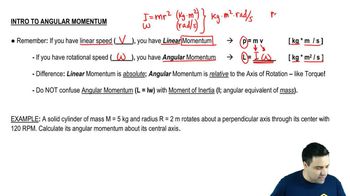
Intro to Angular Momentum

Linear Speed

Linear speed refers to the distance traveled per unit of time by a point on a rotating object. It can be calculated using the formula v = rω, where v is the linear speed, r is the radius (distance from the axis of rotation), and ω is the angular velocity. In this case, the linear speed of the point on the platter is determined by its distance from the rotation axis and the angular velocity derived from the platter's rpm.
Recommended video:
Guided course
07:31
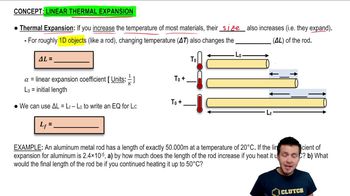
Linear Thermal Expansion

Centripetal Motion

Centripetal motion describes the motion of an object moving in a circular path, requiring a net inward force to maintain that path. In the context of the hard drive platter, the reading head experiences centripetal acceleration due to the circular motion of the platter. Understanding this concept is crucial for analyzing forces acting on the reading head and ensuring it remains properly aligned with the rotating platter.
Recommended video:
Guided course
06:48
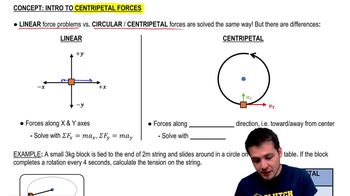
Intro to Centripetal Forces