Ch 12: Rotation of a Rigid Body
Knight Calc - Physics for Scientists and Engineers 5th Edition
Knight Calc5th EditionPhysics for Scientists and EngineersISBN: 9780137344796Not the one you use?Change textbook
Chapter 12, Problem 53

Calculate by direct integration the moment of inertia for a thin rod of mass M and length L about an axis located distance d from one end. Confirm that your answer agrees with Table 12.2 when d=0 and when d = L/2.

Verified step by step guidance
1
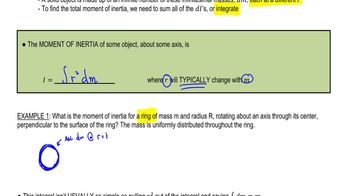
Step 1: Define the moment of inertia formula for a continuous mass distribution. The moment of inertia is given by \( I = \int r^2 \, dm \), where \( r \) is the distance from the axis of rotation to the mass element \( dm \).
Step 2: Express \( dm \) in terms of the linear mass density \( \lambda \). For a thin rod, \( \lambda = \frac{M}{L} \), where \( M \) is the total mass and \( L \) is the length of the rod. Thus, \( dm = \lambda \, dx = \frac{M}{L} \, dx \), where \( dx \) is the infinitesimal length element.
Step 3: Set up the integral for the moment of inertia. The distance \( r \) from the axis of rotation to the mass element depends on the position \( x \) along the rod. If the axis is located at a distance \( d \) from one end, then \( r = x - d \). Substitute \( r \) and \( dm \) into the formula: \( I = \int_{d}^{d+L} (x - d)^2 \frac{M}{L} \, dx \).
Step 4: Simplify the integral. Expand \( (x - d)^2 \) to \( x^2 - 2dx + d^2 \), and distribute \( \frac{M}{L} \): \( I = \frac{M}{L} \int_{d}^{d+L} (x^2 - 2dx + d^2) \, dx \). Break this into three separate integrals: \( I = \frac{M}{L} \left[ \int_{d}^{d+L} x^2 \, dx - 2d \int_{d}^{d+L} x \, dx + d^2 \int_{d}^{d+L} 1 \, dx \right] \).
Step 5: Evaluate each integral. Use the standard rules for integration: \( \int x^n \, dx = \frac{x^{n+1}}{n+1} \), \( \int x \, dx = \frac{x^2}{2} \), and \( \int 1 \, dx = x \). Substitute the limits of integration \( d \) and \( d+L \) into each term. After simplifying, confirm the result for \( d = 0 \) and \( d = \frac{L}{2} \) to verify agreement with Table 12.2.

Verified video answer for a similar problem:

This video solution was recommended by our tutors as helpful for the problem above.
Was this helpful?

Key Concepts

Here are the essential concepts you must grasp in order to answer the question correctly.

Moment of Inertia

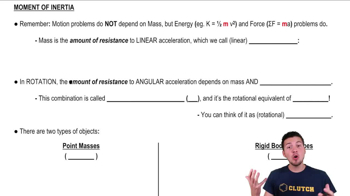
The moment of inertia is a measure of an object's resistance to rotational motion about a specific axis. It depends on the mass distribution relative to that axis, with greater distances from the axis resulting in a higher moment of inertia. For a thin rod, the moment of inertia can be calculated using integration, taking into account the mass elements and their distances from the axis of rotation.
Recommended video:
Guided course
11:47
Intro to Moment of Inertia

Direct Integration

Direct integration is a mathematical technique used to find the total value of a function over a specified interval. In the context of calculating moment of inertia, it involves integrating the product of mass elements and the square of their distances from the axis of rotation. This method allows for precise calculations of complex shapes and mass distributions.
Recommended video:
Guided course
11:43
Finding Moment Of Inertia By Integrating

Axis of Rotation

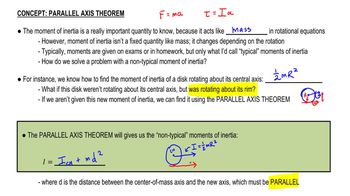
The axis of rotation is the line about which an object rotates. The choice of this axis significantly affects the moment of inertia, as it determines how mass is distributed relative to the axis. In this problem, the axis is located a distance d from one end of the rod, and understanding its position is crucial for accurately calculating the moment of inertia.
Recommended video:
Guided course
13:46
Parallel Axis Theorem