Ch 31: Electromagnetic Fields and Waves
Knight Calc - Physics for Scientists and Engineers 5th Edition
Knight Calc5th EditionPhysics for Scientists and EngineersISBN: 9780137344796Not the one you use?Change textbook
Chapter 31, Problem 14c

The electric field of an electromagnetic wave in a vacuum is Ey=(20.0 V/m)cos[(6.28×108)xωt]E_y = (20.0 \(\text{ V/m}\)) \(\cos\)[(6.28 \(\times\) 10^8)x - \(\omega\) t], where x is in m and t is in s. What are the wave's magnetic field amplitude?

Verified step by step guidance
1
The relationship between the electric field amplitude (E₀) and the magnetic field amplitude (B₀) in an electromagnetic wave is given by the equation: B_0 = \(\frac{E_0}{c}\), where c is the speed of light in a vacuum (c = 3.00 \(\times\) 10^8 \(\text{ m/s}\)).
From the problem, the electric field amplitude is given as E_0 = 20.0 \(\text{ V/m}\). Substitute this value into the equation for B_0.
The equation becomes: B_0 = \(\frac{20.0}{3.00 \times 10^8}\). Perform the division to find the magnetic field amplitude.
Ensure that the units are consistent. The result for B_0 will be in teslas (T), as the magnetic field is measured in teslas.
The final value of B_0 represents the magnetic field amplitude of the electromagnetic wave in the vacuum.

Verified video answer for a similar problem:

This video solution was recommended by our tutors as helpful for the problem above.
Was this helpful?

Key Concepts

Here are the essential concepts you must grasp in order to answer the question correctly.

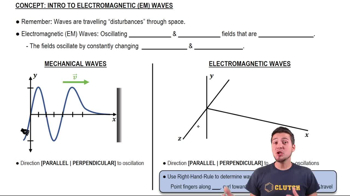
Electromagnetic Waves

Electromagnetic waves are oscillations of electric and magnetic fields that propagate through space. They travel at the speed of light in a vacuum and consist of perpendicular electric (E) and magnetic (B) fields. The relationship between these fields is described by Maxwell's equations, which govern how electric and magnetic fields interact and propagate.
Recommended video:
Guided course
05:22
Introduction to Electromagnetic (EM) Waves

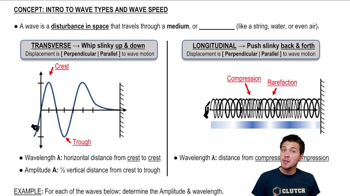
Amplitude of a Wave

The amplitude of a wave refers to the maximum extent of a wave's oscillation from its rest position. In the context of electromagnetic waves, the amplitude of the electric field (E) is directly related to the amplitude of the magnetic field (B) through the equation B = E/c, where c is the speed of light. This relationship allows us to determine the magnetic field amplitude when the electric field amplitude is known.
Recommended video:
Guided course
07:19
Intro to Waves and Wave Speed

Wave Equation and Angular Frequency

The wave equation describes the propagation of waves through space and time, often expressed in the form E = E₀ cos(kx - ωt), where E₀ is the amplitude, k is the wave number, and ω is the angular frequency. The angular frequency (ω) relates to the frequency (f) of the wave by the equation ω = 2πf. Understanding these parameters is essential for analyzing wave behavior and calculating related quantities such as the magnetic field amplitude.
Recommended video:
Guided course
06:28
Equations for Transverse Standing Waves