Ch 31: Electromagnetic Fields and Waves
Knight Calc - Physics for Scientists and Engineers 5th Edition
Knight Calc5th EditionPhysics for Scientists and EngineersISBN: 9780137344796Not the one you use?Change textbook
Chapter 31, Problem 8a

A 10-cm-diameter parallel-plate capacitor has a 1.0 mm spacing. The electric field between the plates is increasing at the rate 1.0×10⁶ V/m s. What is the magnetic field strength on the axis?

Verified step by step guidance
1
Step 1: Understand the problem. The problem involves a parallel-plate capacitor with a changing electric field. This changing electric field induces a magnetic field according to Maxwell's equations. Specifically, we will use the concept of displacement current and Ampere-Maxwell law to find the magnetic field strength on the axis.
Step 2: Write down the given values. The diameter of the capacitor plates is 10 cm (convert to meters: 0.1 m), the spacing between the plates is 1.0 mm (convert to meters: 0.001 m), and the rate of change of the electric field is 1.0×10^6 V/m/s.
Step 3: Calculate the displacement current density. The displacement current density \( J_d \) is given by \( J_d = \epsilon_0 \frac{dE}{dt} \), where \( \epsilon_0 \) is the permittivity of free space (\( \epsilon_0 = 8.85 \times 10^{-12} \, \text{F/m} \)) and \( \frac{dE}{dt} \) is the rate of change of the electric field.
Step 4: Use Ampere-Maxwell law to find the magnetic field strength. The magnetic field strength \( B \) on the axis of the capacitor is given by \( B = \frac{\mu_0 J_d A}{2 \pi r} \), where \( \mu_0 \) is the permeability of free space (\( \mu_0 = 4\pi \times 10^{-7} \text{T·m/A} \)), \( A \) is the area of the capacitor plates (\( A = \pi r^2 \)), and \( r \) is the radial distance from the axis (here, \( r = 0 \) since we are calculating on the axis).
Step 5: Substitute the values into the formula. Calculate \( J_d \) using \( \epsilon_0 \frac{dE}{dt} \), then substitute \( J_d \), \( \mu_0 \), and \( A \) into the formula for \( B \). Simplify the expression to find the magnetic field strength on the axis.

Verified video answer for a similar problem:

This video solution was recommended by our tutors as helpful for the problem above.
Was this helpful?

Key Concepts

Here are the essential concepts you must grasp in order to answer the question correctly.

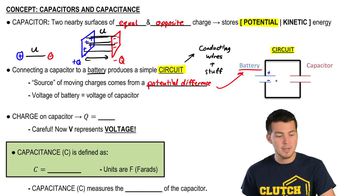
Capacitance

Capacitance is the ability of a system to store electric charge per unit voltage. For a parallel-plate capacitor, it is determined by the area of the plates and the distance between them, given by the formula C = ε₀(A/d), where ε₀ is the permittivity of free space, A is the area of one plate, and d is the separation between the plates.
Recommended video:
Guided course
08:02
Capacitors & Capacitance (Intro)

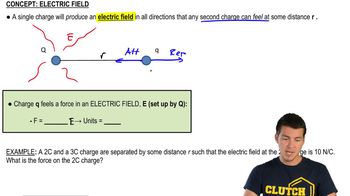
Electric Field

The electric field (E) is a vector field that represents the force per unit charge experienced by a positive test charge placed in the field. In a parallel-plate capacitor, the electric field is uniform and can be calculated using E = V/d, where V is the voltage across the plates and d is the distance between them. The problem states that this electric field is increasing over time.
Recommended video:
Guided course
03:16
Intro to Electric Fields

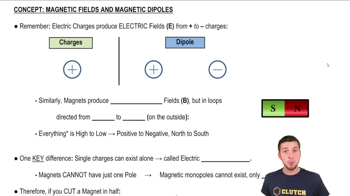
Magnetic Field Induction

According to Maxwell's equations, a changing electric field induces a magnetic field. This phenomenon is described by Faraday's law of electromagnetic induction and the displacement current concept. In this scenario, the increasing electric field between the capacitor plates generates a magnetic field, which can be calculated using the relationship B = (μ₀/2)(dE/dt) for the magnetic field strength at the axis of the capacitor.
Recommended video:
Guided course
05:30
Magnetic Fields and Magnetic Dipoles