Ch 31: Electromagnetic Fields and Waves
Knight Calc - Physics for Scientists and Engineers 5th Edition
Knight Calc5th EditionPhysics for Scientists and EngineersISBN: 9780137344796Not the one you use?Change textbook
Chapter 31, Problem 2b

A rocket cruises past a laboratory at 1.00×10⁶ m/s in the positive x-direction just as a proton is launched with velocity (in the laboratory frame) v=(1.41×10⁶i^+1.41×10⁶j^)\(\vec{v}\) = (1.41 \(\times\) 10^6\,\(\hat{i}\) + 1.41 \(\times\) 10^6\,\(\hat{j}\)) m/s. What are the proton's speed and its angle from the y-axis in the rocket frame?

Verified step by step guidance
1
Step 1: Recognize that this is a problem involving relative velocity in special relativity. The velocities given are in the laboratory frame, and we need to transform them into the rocket frame using the relativistic velocity transformation equations.
Step 2: Write down the relativistic velocity transformation equations for the x and y components of the proton's velocity. For the x-component: \( v'_x = \frac{v_x - u}{1 - \frac{v_x u}{c^2}} \), where \( v_x \) is the x-component of the proton's velocity in the lab frame, \( u \) is the velocity of the rocket relative to the lab, and \( c \) is the speed of light. For the y-component: \( v'_y = \frac{v_y}{\gamma (1 - \frac{v_x u}{c^2})} \), where \( \gamma = \frac{1}{\sqrt{1 - \frac{u^2}{c^2}}} \).
Step 3: Substitute the given values into the equations. The x-component of the proton's velocity in the lab frame is \( v_x = 1.41 \times 10^6 \, \text{m/s} \), the y-component is \( v_y = 1.41 \times 10^6 \, \text{m/s} \), and the rocket's velocity is \( u = 1.00 \times 10^6 \, \text{m/s} \). Use \( c = 3.00 \times 10^8 \, \text{m/s} \) for the speed of light.
Step 4: Calculate the transformed x and y components of the proton's velocity in the rocket frame using the equations from Step 2. First, compute \( \gamma \) using \( \gamma = \frac{1}{\sqrt{1 - \frac{u^2}{c^2}}} \). Then, substitute \( \gamma \), \( v_x \), \( v_y \), and \( u \) into the equations for \( v'_x \) and \( v'_y \).
Step 5: Determine the proton's speed and angle in the rocket frame. The speed is given by \( v' = \sqrt{v'_x^2 + v'_y^2} \), and the angle from the y-axis is \( \theta = \arctan\left(\frac{v'_x}{v'_y}\right) \). Use the transformed components \( v'_x \) and \( v'_y \) from Step 4 to compute these quantities.

Verified video answer for a similar problem:

This video solution was recommended by our tutors as helpful for the problem above.
Video duration:
6m
Was this helpful?

Key Concepts

Here are the essential concepts you must grasp in order to answer the question correctly.

Relative Velocity

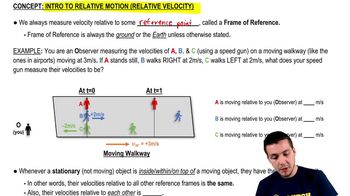
Relative velocity is the velocity of one object as observed from another moving object. In this scenario, the rocket's frame of reference is moving at a significant speed, so to find the proton's velocity in the rocket's frame, we must subtract the rocket's velocity from the proton's velocity. This concept is crucial for understanding how motion is perceived differently depending on the observer's frame of reference.
Recommended video:
Guided course
04:27
Intro to Relative Motion (Relative Velocity)

Vector Addition

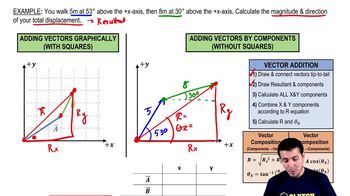
Vector addition involves combining two or more vectors to determine a resultant vector. In this problem, both the rocket's and the proton's velocities are represented as vectors. To find the proton's velocity in the rocket's frame, we need to perform vector subtraction, which requires understanding how to manipulate vector components in two dimensions.
Recommended video:
Guided course
07:30
Vector Addition By Components

Speed and Direction

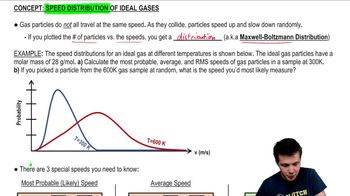
Speed is a scalar quantity that represents how fast an object is moving, while direction indicates the path along which the object moves. In this context, after calculating the proton's velocity in the rocket's frame, we need to determine its speed (magnitude of the velocity vector) and the angle it makes with the y-axis. This involves using trigonometric functions to find the angle based on the vector components.
Recommended video:
Guided course
07:59
Speed Distribution & Special Speeds of Ideal Gases