
Ch 31: Electromagnetic Fields and Waves
Knight Calc - Physics for Scientists and Engineers 5th Edition
Knight Calc5th EditionPhysics for Scientists and EngineersISBN: 9780137344796Not the one you use?Change textbook
Chapter 31, Problem 18

A radio receiver can detect signals with electric field amplitudes as small as 300 μV/m. What is the intensity of the smallest detectable signal?

Verified step by step guidance
1
Understand the relationship between the electric field amplitude and intensity. The intensity \( I \) of an electromagnetic wave is related to the electric field amplitude \( E \) by the formula: \( I = \frac{1}{2} \varepsilon_0 c E^2 \), where \( \varepsilon_0 \) is the permittivity of free space (\( 8.85 \times 10^{-12} \ \text{F/m} \)) and \( c \) is the speed of light in a vacuum (\( 3.00 \times 10^8 \ \text{m/s} \)).
Convert the given electric field amplitude \( E \) from microvolts per meter (\( \mu \text{V/m} \)) to volts per meter (\( \text{V/m} \)). Since \( 1 \ \mu \text{V/m} = 10^{-6} \ \text{V/m} \), the given value of \( 300 \ \mu \text{V/m} \) becomes \( 300 \times 10^{-6} \ \text{V/m} \).
Substitute the values of \( \varepsilon_0 \), \( c \), and the converted \( E \) into the intensity formula: \( I = \frac{1}{2} \varepsilon_0 c E^2 \).
Simplify the expression by squaring the electric field amplitude \( E \) and multiplying it with \( \varepsilon_0 \) and \( c \). Then divide the result by 2 to find the intensity.
Ensure the units are consistent throughout the calculation, and the final intensity \( I \) will be in watts per square meter (\( \text{W/m}^2 \)).

Verified video answer for a similar problem:

This video solution was recommended by our tutors as helpful for the problem above.
Was this helpful?

Key Concepts

Here are the essential concepts you must grasp in order to answer the question correctly.

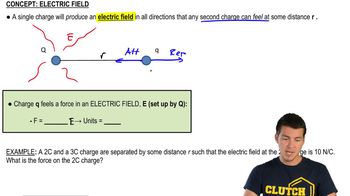
Electric Field Amplitude

Electric field amplitude refers to the maximum strength of an electric field, measured in volts per meter (V/m). In the context of radio signals, it indicates how strong the electric field component of the electromagnetic wave is. A higher amplitude means a stronger signal, which is easier for a receiver to detect.
Recommended video:
Guided course
03:16
Intro to Electric Fields

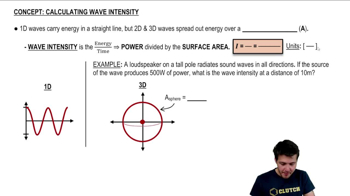
Intensity of a Signal

The intensity of a signal is defined as the power per unit area carried by the wave, typically measured in watts per square meter (W/m²). It is proportional to the square of the electric field amplitude. Understanding this relationship is crucial for calculating the intensity from the given electric field amplitude.
Recommended video:
Guided course
02:32
Wave Intensity

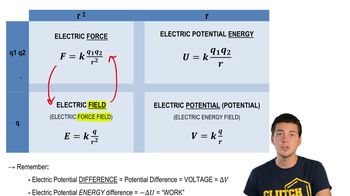
Relationship Between Electric Field and Intensity

The intensity (I) of an electromagnetic wave is related to the electric field amplitude (E) by the equation I = (E²)/(Z), where Z is the impedance of free space (approximately 377 ohms). This relationship allows us to convert the electric field amplitude of the detected signal into its corresponding intensity, which is essential for understanding the signal's detectability.
Recommended video:
Guided course
03:43
Relationships Between Force, Field, Energy, Potential