Ch. 19 - Heat and the First Law of Thermodynamics
Giancoli Douglas - Physics for Scientists and Engineers 5th edition
Giancoli Douglas5th editionPhysics for Scientists and EngineersISBN: 9780137488179Not the one you use?Change textbook
Chapter 19, Problem 9

What is the specific heat of a metal substance if 165 kJ of heat is needed to raise 4.1 kg of the metal from 18.0°C to 37.2°C?

Verified step by step guidance
1
Identify the formula for specific heat: c = QmΔT, where Q is the heat added, m is the mass of the substance, and ΔT is the change in temperature.
Calculate the temperature change: ΔT = Tfinal - Tinitial. Substitute the given values: ΔT = 37.2 - 18.0 (in °C).
Substitute the given values into the formula: Q = 165,000 J (convert kJ to J), m = 4.1 kg, and the calculated ΔT from the previous step.
Rearrange the formula to solve for c: c = QmΔT. Substitute the values into this equation.
Simplify the expression to find the specific heat c in units of J/(kg·°C).

Verified video answer for a similar problem:

This video solution was recommended by our tutors as helpful for the problem above.
Video duration:
2m
Was this helpful?

Key Concepts

Here are the essential concepts you must grasp in order to answer the question correctly.

Specific Heat Capacity

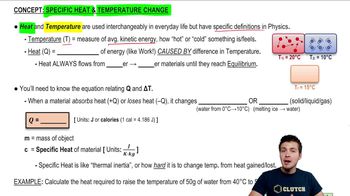
Specific heat capacity is the amount of heat required to raise the temperature of one kilogram of a substance by one degree Celsius. It is a material property that varies between different substances and is crucial for understanding how much energy is needed to change the temperature of a given mass.
Recommended video:
Guided course
06:50
Specific Heat & Temperature Changes

Heat Transfer

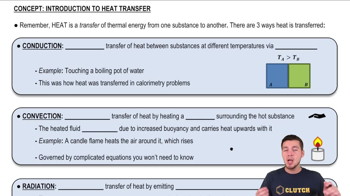
Heat transfer refers to the movement of thermal energy from one object or substance to another due to a temperature difference. In this context, it is the heat energy supplied to the metal that causes its temperature to rise, which can be calculated using the specific heat formula.
Recommended video:
Guided course
05:14
Overview of Heat Transfer

Thermal Energy Equation

The thermal energy equation, often expressed as Q = mcΔT, relates the heat added (Q) to the mass (m) of the substance, its specific heat capacity (c), and the change in temperature (ΔT). This equation is fundamental for solving problems involving heat transfer and temperature changes in materials.
Recommended video:
Guided course
05:21
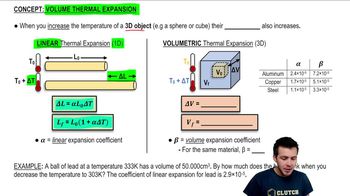
Volume Thermal Expansion