
Ch. 19 - Heat and the First Law of Thermodynamics
Giancoli Douglas - Physics for Scientists and Engineers 5th edition
Giancoli Douglas5th editionPhysics for Scientists and EngineersISBN: 9780137488179Not the one you use?Change textbook
Chapter 19, Problem 11

(a) How long does it take a 750-W coffeepot to bring to a boil 0.75 L of water at sea level initially at 11°C? Assume that the part of the pot which is heated with the water is made of 250 g of aluminum, and that no water boils away.
(b) For how long could this amount of energy run a 60-W lightbulb?

Verified step by step guidance
1
Step 1: Calculate the total energy required to heat the water. Use the formula for heat transfer: Q = mcΔT, where m is the mass of the water, c is the specific heat capacity of water (approximately 4186 J/(kg·°C)), and ΔT is the temperature change. Convert the volume of water (0.75 L) to mass (in kg) using the density of water (1 kg/L).
Step 2: Calculate the energy required to heat the aluminum part of the pot. Use the same formula Q = mcΔT, but this time for aluminum. The mass of the aluminum is 250 g (convert to kg), and the specific heat capacity of aluminum is approximately 900 J/(kg·°C). Add this energy to the energy required for the water to get the total energy.
Step 3: Determine the time required to supply this energy using the coffeepot's power. Use the formula P = Q/t, where P is the power of the coffeepot (750 W), Q is the total energy calculated in the previous steps, and t is the time. Rearrange to solve for t: t = Q/P.
Step 4: For part (b), calculate the total time a 60-W lightbulb could run using the same amount of energy. Use the formula P = Q/t, but this time rearrange to solve for t: t = Q/P, where P is the power of the lightbulb (60 W).
Step 5: Ensure all units are consistent throughout the calculations (e.g., mass in kg, temperature in °C, power in watts, and energy in joules). Perform the calculations step by step to find the time for both the coffeepot and the lightbulb.

Verified video answer for a similar problem:

This video solution was recommended by our tutors as helpful for the problem above.
Video duration:
14m
Was this helpful?

Key Concepts

Here are the essential concepts you must grasp in order to answer the question correctly.

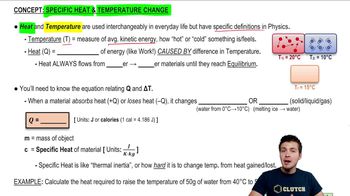
Specific Heat Capacity

Specific heat capacity is the amount of heat required to raise the temperature of a unit mass of a substance by one degree Celsius. For water, this value is approximately 4.18 J/g°C. In this problem, it is essential to calculate the energy needed to heat the water from its initial temperature to its boiling point, which involves using the specific heat capacity of water.
Recommended video:
Guided course
06:50
Specific Heat & Temperature Changes

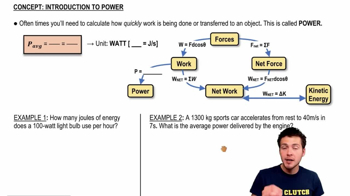
Energy Transfer and Power

Power is the rate at which energy is transferred or converted, measured in watts (W), where 1 W = 1 J/s. The coffeepot's power rating of 750 W indicates how much energy it can provide per second. To find out how long it takes to heat the water, one must calculate the total energy required and then divide it by the power of the coffeepot.
Recommended video:

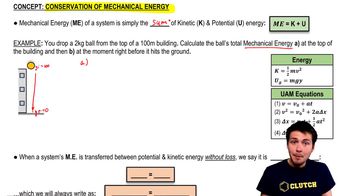
Energy Conservation

The principle of energy conservation states that energy cannot be created or destroyed, only transformed from one form to another. In this scenario, the energy used by the coffeepot to heat the water can be calculated and then compared to the energy consumption of a 60-W lightbulb to determine how long the same amount of energy could power the bulb.
Recommended video:
Guided course
06:24
Conservation Of Mechanical Energy