Ch. 19 - Heat and the First Law of Thermodynamics
Giancoli Douglas - Physics for Scientists and Engineers 5th edition
Giancoli Douglas5th editionPhysics for Scientists and EngineersISBN: 9780137488179Not the one you use?Change textbook
Chapter 19, Problem 3

An average active person consumes about 2500 Cal a day.
(a) What is this in joules?
(b) What is this in kilowatt-hours?
(c) If your power company charges about per kilowatt-hour, how much would your energy cost per day if you bought it from the power company? Could you feed yourself on this much money per day?

Verified step by step guidance
1
Step 1: Convert the energy from calories to joules. Use the conversion factor: 1 Cal (food calorie) = 4184 J. Multiply 2500 Cal by 4184 J/Cal to find the energy in joules.
Step 2: Convert the energy from joules to kilowatt-hours. Use the conversion factor: 1 kilowatt-hour (kWh) = 3.6 × 10^6 J. Divide the energy in joules by 3.6 × 10^6 J/kWh to find the energy in kilowatt-hours.
Step 3: Calculate the cost of this energy if purchased from a power company. Multiply the energy in kilowatt-hours by the cost per kilowatt-hour (assume the cost is given, e.g., \$0.12 per kWh).
Step 4: Compare the calculated energy cost to the cost of feeding yourself. Consider whether the energy cost is higher or lower than the daily cost of food.
Step 5: Reflect on the efficiency of biological energy consumption versus electrical energy consumption, noting that the human body is highly efficient at converting food energy into usable energy for daily activities.

Verified video answer for a similar problem:

This video solution was recommended by our tutors as helpful for the problem above.
Was this helpful?

Key Concepts

Here are the essential concepts you must grasp in order to answer the question correctly.

Calorie to Joule Conversion

A calorie (Cal) is a unit of energy defined as the amount of heat needed to raise the temperature of one gram of water by one degree Celsius. In physics, energy is often measured in joules (J), where 1 Cal is equivalent to approximately 4.184 joules. Understanding this conversion is essential for translating dietary energy consumption into a more universally recognized energy unit.
Recommended video:
Guided course
07:46
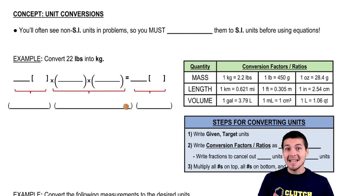
Unit Conversions

Kilowatt-Hour (kWh)

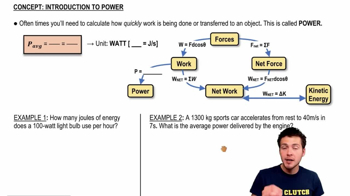
A kilowatt-hour is a unit of energy equivalent to one kilowatt (1000 watts) of power used for one hour. It is commonly used by electric companies to measure energy consumption. To convert joules to kilowatt-hours, one can use the conversion factor where 1 kWh equals 3.6 million joules. This concept is crucial for understanding energy costs in terms of household electricity usage.
Recommended video:

Cost of Energy

The cost of energy refers to the price paid for electricity, typically measured in cents per kilowatt-hour. To determine daily energy costs based on personal energy consumption, one can multiply the daily kWh usage by the cost per kWh. This concept helps in evaluating the economic feasibility of energy consumption from a power company compared to dietary energy intake.
Recommended video:
Guided course
04:10
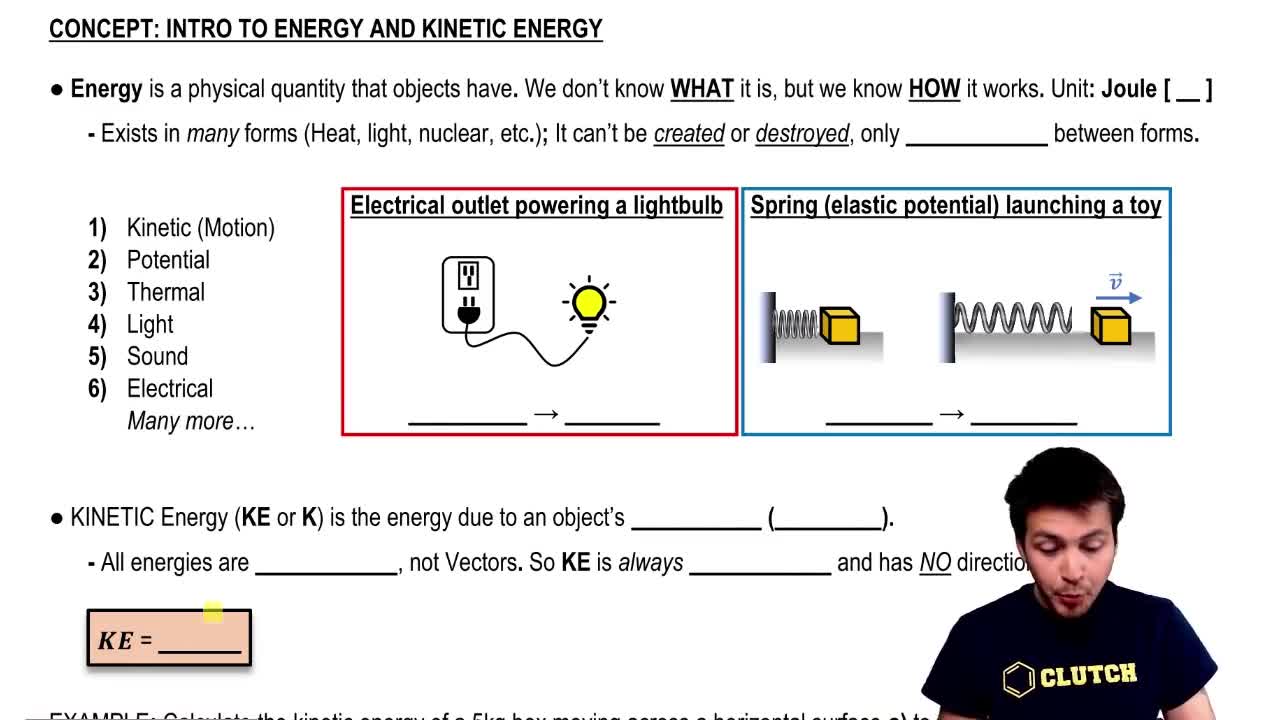
Intro to Energy & Types of Energy