Ch 16: Traveling Waves
Knight Calc - Physics for Scientists and Engineers 5th Edition
Knight Calc5th EditionPhysics for Scientists and EngineersISBN: 9780137344796Not the one you use?Change textbook
Chapter 16, Problem 45c

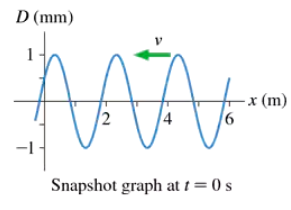
FIGURE P16.45 is a snapshot graph at t = 0 s of a 5.0 Hz wave traveling to the left. Write the displacement equation for this wave.

Verified step by step guidance
1
Step 1: Analyze the graph to determine the amplitude (A), wavelength (λ), and frequency (f) of the wave. From the graph, the amplitude is 2 mm (maximum displacement from equilibrium), the wavelength is 2 m (distance between two consecutive peaks), and the frequency is given as 5.0 Hz.
Step 2: Use the relationship between frequency (f) and angular frequency (ω) to calculate ω. The formula is ω = 2πf. Substituting f = 5.0 Hz, ω = 2π × 5.0 rad/s.
Step 3: Use the relationship between wavelength (λ) and wave number (k) to calculate k. The formula is k = 2π/λ. Substituting λ = 2 m, k = 2π/2 rad/m.
Step 4: Write the general displacement equation for a traveling wave moving to the left. The equation is y(x, t) = A sin(kx + ωt). Since the wave is traveling to the left, the phase term includes a positive sign for ωt.
Step 5: Substitute the values of A, k, and ω into the displacement equation. A = 2 mm, k = π rad/m, and ω = 10π rad/s. The displacement equation becomes y(x, t) = 2 sin(πx + 10πt) mm.

Verified video answer for a similar problem:

This video solution was recommended by our tutors as helpful for the problem above.
Video duration:
3m
Was this helpful?

Key Concepts

Here are the essential concepts you must grasp in order to answer the question correctly.

Wave Equation

The wave equation describes the displacement of a wave as a function of position and time. For a sinusoidal wave, it is typically expressed as y(x, t) = A sin(kx - ωt + φ), where A is the amplitude, k is the wave number, ω is the angular frequency, and φ is the phase constant. This equation allows us to model how the wave propagates through space and time.
Recommended video:
Guided course
06:28
Equations for Transverse Standing Waves

Frequency and Angular Frequency

Frequency (f) is the number of cycles a wave completes in one second, measured in Hertz (Hz). Angular frequency (ω) is related to frequency by the equation ω = 2πf. In this case, with a frequency of 5.0 Hz, the angular frequency can be calculated as ω = 2π(5.0) rad/s, which is essential for determining the wave's behavior over time.
Recommended video:
Guided course
05:08
Circumference, Period, and Frequency in UCM

Wave Number

The wave number (k) is defined as the number of wavelengths per unit distance and is given by the formula k = 2π/λ, where λ is the wavelength. The wavelength can be determined from the graph by measuring the distance between successive peaks. Understanding the wave number is crucial for writing the displacement equation accurately, as it relates to the spatial characteristics of the wave.
Recommended video:
Guided course
07:19
Moles & Avogadro's Number
Related Practice
Textbook Question

A friend of yours is loudly singing a single note at 400 Hz while racing toward you at 25.0 m/s on a day when the speed of sound is 340 m/s. What frequency do you hear?

2
views

Textbook Question

What are the sound intensity levels for sound waves of intensity 3.0 x 10⁻⁶ W/m2?

1
views
Textbook Question

String 1 in FIGURE P16.47 has linear density 2.0 g/m and string 2 has linear density. A student sends pulses in both directions by quickly pulling up on the knot, then releasing it. What should the string lengths L₁ and L₂ be if the pulses are to reach the ends of the strings simultaneously?

1
views
Textbook Question

A bat locates insects by emitting ultrasonic 'chirps' and then listening for echoes from the bugs. Suppose a bat chirp has a frequency of 25 kHz. How fast would the bat have to fly, and in what direction, for you to just barely be able to hear the chirp at 20 kHz?

2
views
Textbook Question

Earthquakes are essentially sound waves—called seismic waves—traveling through the earth. Because the earth is solid, it can support both longitudinal and transverse seismic waves. The speed of longitudinal waves, called P waves, is 8000 m/s. Transverse waves, called S waves, travel at a slower 4500 m/s. A seismograph records the two waves from a distant earthquake. If the S wave arrives 2.0 min after the P wave, how far away was the earthquake? You can assume that the waves travel in straight lines, although actual seismic waves follow more complex routes.

1
views
Textbook Question

A helium-neon laser beam has a wavelength in air of 633 nm. It takes 1.38 ns for the light to travel through 30 cm of an unknown liquid. What is the wavelength of the laser beam in the liquid?

1
views