Ch 16: Traveling Waves
Knight Calc - Physics for Scientists and Engineers 5th Edition
Knight Calc5th EditionPhysics for Scientists and EngineersISBN: 9780137344796Not the one you use?Change textbook
Chapter 16, Problem 42a

A friend of yours is loudly singing a single note at 400 Hz while racing toward you at 25.0 m/s on a day when the speed of sound is 340 m/s. What frequency do you hear?

Verified step by step guidance
1
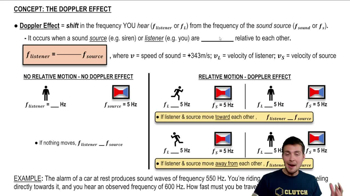
Identify the problem as a Doppler Effect scenario, where the frequency of a sound changes due to the relative motion between the source (your friend) and the observer (you). The formula for the observed frequency \( f' \) is: \( f' = f \frac{v + v_o}{v - v_s} \), where \( f \) is the source frequency, \( v \) is the speed of sound, \( v_o \) is the speed of the observer, and \( v_s \) is the speed of the source.
Since you (the observer) are stationary, \( v_o = 0 \). The formula simplifies to: \( f' = f \frac{v}{v - v_s} \).
Substitute the given values into the formula: \( f = 400 \ \text{Hz} \), \( v = 340 \ \text{m/s} \), and \( v_s = 25.0 \ \text{m/s} \). The equation becomes: \( f' = 400 \cdot \frac{340}{340 - 25.0} \).
Simplify the denominator: \( 340 - 25.0 = 315.0 \). The equation now reads: \( f' = 400 \cdot \frac{340}{315.0} \).
To find the observed frequency \( f' \), calculate the fraction \( \frac{340}{315.0} \) and multiply it by 400. This will give you the frequency you hear as your friend approaches.

Verified video answer for a similar problem:

This video solution was recommended by our tutors as helpful for the problem above.
Video duration:
4m
Was this helpful?

Key Concepts

Here are the essential concepts you must grasp in order to answer the question correctly.

Doppler Effect

The Doppler Effect describes the change in frequency or wavelength of a wave in relation to an observer moving relative to the source of the wave. When the source of sound moves toward an observer, the frequency increases, resulting in a higher pitch. Conversely, if the source moves away, the frequency decreases. This phenomenon is crucial for understanding how the frequency of sound changes based on the relative motion of the source and the observer.
Recommended video:
Guided course
07:40
The Doppler Effect

Frequency and Wavelength

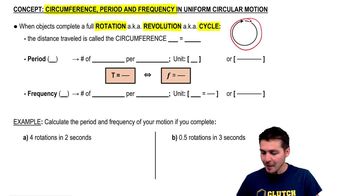
Frequency is the number of cycles of a wave that occur in a unit of time, typically measured in Hertz (Hz). Wavelength is the distance between successive crests of a wave. The relationship between frequency and wavelength is inversely proportional; as frequency increases, wavelength decreases. Understanding this relationship is essential for calculating the perceived frequency of sound when the source is in motion.
Recommended video:
Guided course
05:08
Circumference, Period, and Frequency in UCM

Speed of Sound

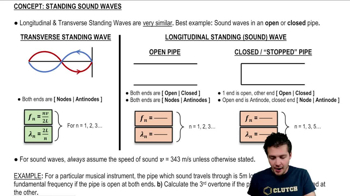
The speed of sound is the rate at which sound waves propagate through a medium, which varies depending on factors like temperature and the medium itself. In air at room temperature, the speed of sound is approximately 340 m/s. This speed is critical for calculating the observed frequency of sound when the source is moving, as it influences how quickly the sound waves reach the observer.
Recommended video:
Guided course
05:17
Standing Sound Waves