
Ch. 19 - Heat and the First Law of Thermodynamics
Giancoli Douglas - Physics for Scientists and Engineers 5th edition
Giancoli Douglas5th editionPhysics for Scientists and EngineersISBN: 9780137488179Not the one you use?Change textbook
Chapter 19, Problem 99a

Calculate what will happen when 1000 J of heat is added to 100 grams of ice at -20°C.

Verified step by step guidance
1
Step 1: Determine the heat required to raise the temperature of the ice from -20°C to 0°C. Use the formula Q=mcΔT, where m is the mass of the ice (100 g = 0.1 kg), c is the specific heat capacity of ice (2,100 J/kg·°C), and ΔT is the temperature change (20°C).
Step 2: Check if the remaining heat is sufficient to melt the ice. The heat required to melt the ice is calculated using the formula Q=mL, where L is the latent heat of fusion for ice (334,000 J/kg).
Step 3: If there is still heat remaining after melting the ice, calculate the heat required to raise the temperature of the resulting water from 0°C to a higher temperature. Use the formula Q=mcΔT, where c is the specific heat capacity of water (4,186 J/kg·°C).
Step 4: Compare the total heat added (1,000 J) to the sum of the heat required for each step. If the heat is insufficient to complete a step, stop at that point and determine the final state of the system (e.g., partially melted ice or water at a certain temperature).
Step 5: Summarize the final state of the system, specifying whether the ice is fully melted, partially melted, or if the water has reached a certain temperature.

Verified video answer for a similar problem:

This video solution was recommended by our tutors as helpful for the problem above.
Video duration:
3m
Was this helpful?

Key Concepts

Here are the essential concepts you must grasp in order to answer the question correctly.

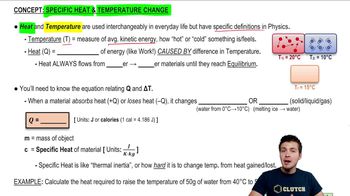
Specific Heat Capacity

Specific heat capacity is the amount of heat required to raise the temperature of a unit mass of a substance by one degree Celsius. For ice, this value is approximately 2.09 J/g°C. Understanding this concept is crucial for calculating how much the temperature of ice will increase when heat is added.
Recommended video:
Guided course
06:50
Specific Heat & Temperature Changes

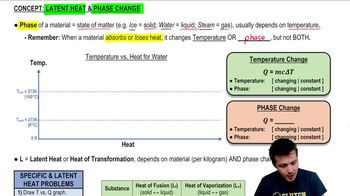
Phase Changes

Phase changes refer to the transitions between solid, liquid, and gas states of matter. When heat is added to ice, it may first increase the temperature until it reaches 0°C, and then the heat will be used to convert the ice into water at the melting point. This process requires additional energy known as the latent heat of fusion.
Recommended video:
Guided course
10:40
Latent Heat & Phase Changes

Energy Conservation

The principle of energy conservation states that energy cannot be created or destroyed, only transformed from one form to another. In this context, the heat energy added to the ice will be converted into thermal energy, which will either increase the temperature of the ice or facilitate its phase change into water, depending on the amount of heat supplied.
Recommended video:
Guided course
06:24
Conservation Of Mechanical Energy