Ch. 19 - Heat and the First Law of Thermodynamics
Giancoli Douglas - Physics for Scientists and Engineers 5th edition
Giancoli Douglas5th editionPhysics for Scientists and EngineersISBN: 9780137488179Not the one you use?Change textbook
Chapter 19, Problem 101a

A leaf of area 40cm² and mass 4.5 x 10⁻⁴ kg directly faces the Sun on a clear day. The leaf has an emissivity of 0.85 and a specific heat of 0.80 kcal/kgK. Estimate the energy absorbed per second by the leaf from the Sun.

Verified step by step guidance
1
Convert the area of the leaf from cm² to m². Since 1 cm² = 1 × 10⁻⁴ m², multiply the given area (40 cm²) by 1 × 10⁻⁴ to get the area in m².
Determine the solar power per unit area (solar constant), which is approximately 1361 W/m². Multiply this value by the area of the leaf (in m²) to calculate the total power incident on the leaf.
Account for the emissivity of the leaf. Since the emissivity (e) is 0.85, the energy absorbed by the leaf is given by the formula: \( P_{absorbed} = e \cdot P_{incident} \), where \( P_{incident} \) is the power incident on the leaf.
The energy absorbed per second is equal to the power absorbed, as power is defined as energy per unit time. Thus, the value of \( P_{absorbed} \) represents the energy absorbed per second by the leaf.
Ensure all units are consistent (e.g., W for power, m² for area) and verify the calculation setup before proceeding to numerical evaluation.

Verified video answer for a similar problem:

This video solution was recommended by our tutors as helpful for the problem above.
Video duration:
7m
Was this helpful?

Key Concepts

Here are the essential concepts you must grasp in order to answer the question correctly.

Solar Radiation

Solar radiation is the energy emitted by the Sun, primarily in the form of electromagnetic waves. The intensity of solar radiation at the Earth's surface is approximately 1000 W/m² on a clear day. This energy is absorbed by surfaces, such as the leaf in the question, which can be calculated using the area and the intensity of sunlight.
Recommended video:
Guided course
07:51
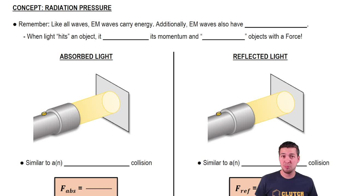
Radiation Pressure

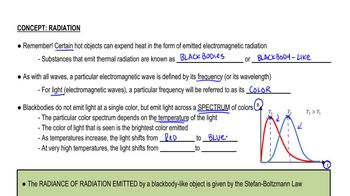
Emissivity

Emissivity is a measure of a material's ability to emit energy as thermal radiation, ranging from 0 to 1. A higher emissivity indicates a better ability to emit energy. In this case, the leaf's emissivity of 0.85 means it can effectively absorb and emit thermal energy, influencing its temperature and energy balance.
Recommended video:

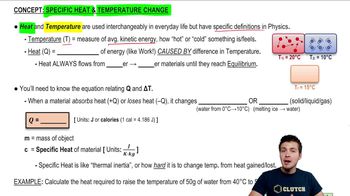
Specific Heat Capacity

Specific heat capacity is the amount of heat required to raise the temperature of a unit mass of a substance by one degree Celsius (or Kelvin). For the leaf, a specific heat of 0.80 kcal/kg·K indicates how much energy is needed to change its temperature, which is crucial for understanding how absorbed solar energy affects the leaf's thermal state.
Recommended video:
Guided course
06:50
Specific Heat & Temperature Changes