

Ch 17: Superposition
Knight Calc - Physics for Scientists and Engineers 5th Edition
Knight Calc5th EditionPhysics for Scientists and EngineersISBN: 9780137344796Not the one you use?Change textbook
Chapter 17, Problem 72a

Piano tuners tune pianos by listening to the beats between the harmonics of two different strings. When properly tuned, the note A should have a frequency of 440 Hz and the note E should be at 659 Hz. What is the frequency difference between the third harmonic of the A and the second harmonic of the E?

Verified step by step guidance
1
Step 1: Understand the concept of harmonics. Harmonics are integer multiples of the fundamental frequency of a vibrating string. For example, the third harmonic of a string is 3 times its fundamental frequency, and the second harmonic is 2 times its fundamental frequency.
Step 2: Calculate the frequency of the third harmonic of the note A. The fundamental frequency of A is 440 Hz, so the third harmonic is given by \( f_{A,3} = 3 \times 440 \).
Step 3: Calculate the frequency of the second harmonic of the note E. The fundamental frequency of E is 659 Hz, so the second harmonic is given by \( f_{E,2} = 2 \times 659 \).
Step 4: Find the frequency difference between the third harmonic of A and the second harmonic of E. This is calculated as \( \Delta f = f_{A,3} - f_{E,2} \).
Step 5: Verify the result conceptually. If the frequency difference is small, it indicates that the beats between the harmonics are slow, which is useful for tuning purposes.

Verified video answer for a similar problem:

This video solution was recommended by our tutors as helpful for the problem above.
Video duration:
3m
Was this helpful?

Key Concepts

Here are the essential concepts you must grasp in order to answer the question correctly.

Harmonics

Harmonics are integer multiples of a fundamental frequency produced by vibrating strings or air columns. For example, the first harmonic (fundamental frequency) is the lowest frequency, while the second harmonic is twice that frequency, and the third harmonic is three times the fundamental frequency. Understanding harmonics is essential for analyzing how different frequencies interact in musical instruments.
Recommended video:
Guided course
07:52
Simple Harmonic Motion of Pendulums

Frequency

Frequency is the number of cycles of a periodic wave that occur in one second, measured in Hertz (Hz). In music, different notes correspond to specific frequencies; for instance, the note A has a frequency of 440 Hz. The frequency of a note determines its pitch, and understanding frequency is crucial for comparing different musical notes.
Recommended video:
Guided course
05:08
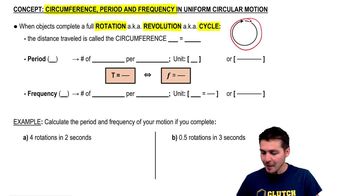
Circumference, Period, and Frequency in UCM

Beats

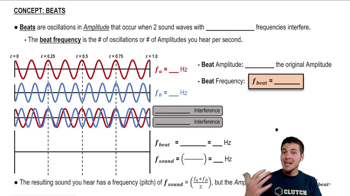
Beats occur when two sound waves of slightly different frequencies interfere with each other, resulting in a fluctuating sound intensity. The beat frequency is equal to the absolute difference between the two frequencies. This phenomenon is important in tuning instruments, as it helps tuners identify when two strings are in harmony or need adjustment.
Recommended video:
Related Practice
Textbook Question

The three identical loudspeakers in FIGURE P17.71 play a 170 Hz tone in a room where the speed of sound is 340 m/s. You are standing 4.0 m in front of the middle speaker. At this point, the amplitude of the wave from each speaker is a. How far must speaker 2 be moved to the left to produce a maximum amplitude at the point where you are standing?

1
views
Textbook Question

The three identical loudspeakers in FIGURE P17.71 play a 170 Hz tone in a room where the speed of sound is 340 m/s. You are standing 4.0 m in front of the middle speaker. At this point, the amplitude of the wave from each speaker is a. When the amplitude is maximum, by what factor is the sound intensity greater than the sound intensity from a single speaker?

1
views
Textbook Question

Piano tuners tune pianos by listening to the beats between the harmonics of two different strings. When properly tuned, the note A should have a frequency of 440 Hz and the note E should be at 659 Hz. The tuner starts with the tension in the E string a little low, then tightens it. What is the frequency of the E string when she hears four beats per second?

1
views
Textbook Question

You have two small, identical boxes that generate 440 Hz notes. While holding one, you drop the other from a 20-m-high balcony. How many beats will you hear before the falling box hits the ground? You can ignore air resistance.

1
views
Textbook Question

A flutist assembles her flute in a room where the speed of sound is 342 m/s. When she plays the note A, it is in perfect tune with a 440 Hz tuning fork. After a few minutes, the air inside her flute has warmed to where the speed of sound is 346 m/s. How far does she need to extend the 'tuning joint' of her flute to be in tune with the tuning fork?

1
views
Textbook Question

Scientists are testing a transparent material whose index of refraction for visible light varies with wavelength as n = 30.0 nm1/21/2 , where λ is in nm. If a 295-nm-thick coating is placed on glass (n=1.50), for what visible wavelengths will the reflected light have maximum constructive interference?

2
views