Ch. 17 - Temperature, Thermal Expansion, and the Ideal Gas Law
Giancoli Douglas - Physics for Scientists and Engineers 5th edition
Giancoli Douglas5th editionPhysics for Scientists and EngineersISBN: 9780137488179Not the one you use?Change textbook
Chapter 17, Problem 36

If 12.50 mol of helium gas is at 10.0°C and a gauge pressure of 0.350 atm, calculate
(a) the volume of the helium gas under these conditions and
(b) the temperature if the gas is compressed to precisely half the volume at a gauge pressure of 1.00 atm.

Verified step by step guidance
1
Step 1: Start by identifying the given values for part (a). The number of moles of helium gas is \( n = 12.50 \), the temperature is \( T = 10.0^{\circ}C \) (convert to Kelvin using \( T(K) = T(^{\circ}C) + 273.15 \)), and the gauge pressure is \( P_{gauge} = 0.350 \ \text{atm} \). Remember to add atmospheric pressure (1.00 atm) to the gauge pressure to get the absolute pressure: \( P = P_{gauge} + 1.00 \ \text{atm} \).
Step 2: Use the ideal gas law \( PV = nRT \) to calculate the volume \( V \). Rearrange the equation to solve for \( V \): \( V = \frac{nRT}{P} \). Here, \( R \) is the ideal gas constant, \( R = 0.0821 \ \text{L·atm/(mol·K)} \). Substitute the known values into the equation to find \( V \).
Step 3: For part (b), note that the gas is compressed to half its original volume, so \( V_{2} = \frac{V_{1}}{2} \). The new gauge pressure is \( P_{gauge,2} = 1.00 \ \text{atm} \), so the absolute pressure is \( P_{2} = P_{gauge,2} + 1.00 \ \text{atm} \). Use the combined gas law \( \frac{P_{1}V_{1}}{T_{1}} = \frac{P_{2}V_{2}}{T_{2}} \) to solve for the new temperature \( T_{2} \).
Step 4: Rearrange the combined gas law to solve for \( T_{2} \): \( T_{2} = \frac{P_{2}V_{2}T_{1}}{P_{1}V_{1}} \). Substitute the known values for \( P_{1} \), \( V_{1} \), \( T_{1} \), \( P_{2} \), and \( V_{2} \) into the equation. Ensure that \( T_{1} \) is in Kelvin.
Step 5: Perform the calculations for both parts (a) and (b) to find the volume \( V \) in part (a) and the temperature \( T_{2} \) in part (b). Ensure that all units are consistent throughout the calculations (e.g., pressure in atm, volume in liters, temperature in Kelvin).

Verified video answer for a similar problem:

This video solution was recommended by our tutors as helpful for the problem above.
Video duration:
9m
Was this helpful?

Key Concepts

Here are the essential concepts you must grasp in order to answer the question correctly.

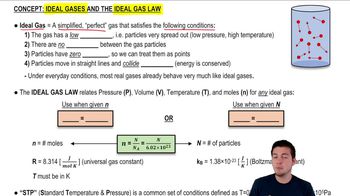
Ideal Gas Law

The Ideal Gas Law is a fundamental equation in thermodynamics that relates the pressure, volume, temperature, and number of moles of a gas. It is expressed as PV = nRT, where P is pressure, V is volume, n is the number of moles, R is the ideal gas constant, and T is temperature in Kelvin. This law allows us to calculate the state of an ideal gas under various conditions.
Recommended video:
Guided course
07:21
Ideal Gases and the Ideal Gas Law

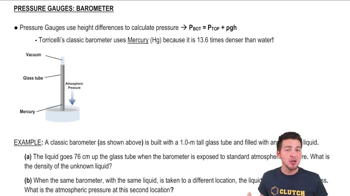
Gauge Pressure

Gauge pressure is the pressure of a system measured relative to the ambient atmospheric pressure. It is calculated by subtracting atmospheric pressure from the absolute pressure of the gas. In this problem, the gauge pressure of helium is given, which means we need to convert it to absolute pressure by adding atmospheric pressure (approximately 1 atm) to find the total pressure acting on the gas.
Recommended video:
Guided course
09:27
Pressure Gauges: Barometer

Charles's Law

Charles's Law states that the volume of a gas is directly proportional to its absolute temperature when pressure is held constant. This relationship can be expressed as V1/T1 = V2/T2. In the context of this problem, if the gas is compressed to half its volume, we can use this law to find the new temperature at the increased pressure, assuming the amount of gas remains constant.
Recommended video: