
A cheetah spots a Thomson's gazelle, its preferred prey, and leaps into action, quickly accelerating to its top speed of 30 m/s, the highest of any land animal. However, a cheetah can maintain this extreme speed for only 15 s before having to let up. The cheetah is 170 m from the gazelle as it reaches top speed, and the gazelle sees the cheetah at just this instant. With negligible reaction time, the gazelle heads directly away from the cheetah, accelerating at 4.6 m/s² for 5.0 s, then running at constant speed. Does the gazelle escape? If so, by what distance is the gazelle in front when the cheetah gives up?
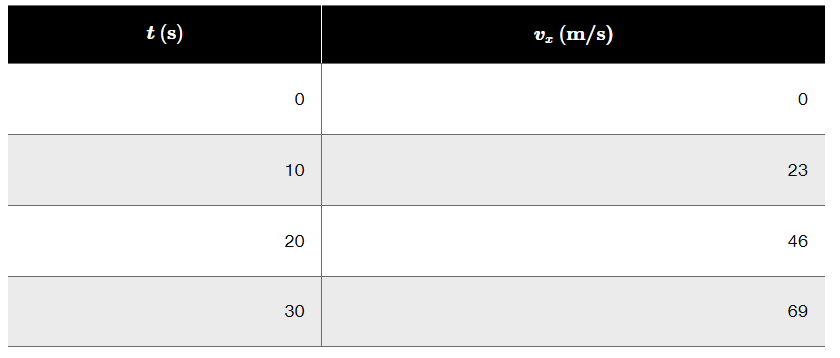
The takeoff speed for an Airbus A320 jetliner is 80 m/s. Velocity data measured during takeoff are as shown. Is the jetliner's acceleration constant during takeoff? Explain.

Verified step by step guidanceKey Concepts
Acceleration
Velocity
Graphical Analysis
You are driving to the grocery store at 20 m/s. You are 110 m from an intersection when the traffic light turns red. Assume that your reaction time is 0.50 s and that your car brakes with constant acceleration. What magnitude braking acceleration will bring you to a stop exactly at the intersection?
Draw position, velocity, and acceleration graphs for the ball shown in FIGURE P2.44. See Problem 43 for more information.
FIGURE P2.45 shows a set of kinematic graphs for a ball rolling on a track. All segments of the track are straight lines, but some may be tilted. Draw a picture of the track and also indicate the ball's initial condition.
You're driving down the highway late one night at 20 m/s when a deer steps onto the road 35 m in front of you. Your reaction time before stepping on the brakes is 0.50 s, and the maximum deceleration of your car is 10 m/s². How much distance is between you and the deer when you come to a stop?
A car starts from rest at a stop sign. It accelerates at 4.0 m/s² for 6.0 s, coasts for 2.0 s, and then slows down at a rate of 3.0 m/s² for the next stop sign. How far apart are the stop signs?
