Ch 22: Electric Charges and Forces
Knight Calc - Physics for Scientists and Engineers 5th Edition
Knight Calc5th EditionPhysics for Scientists and EngineersISBN: 9780137344796Not the one you use?Change textbook
Chapter 22, Problem 15b

Two protons are 2.0 fm apart. What is the magnitude of the gravitational force on one proton due to the other proton?

Verified step by step guidance
1
Step 1: Identify the formula for gravitational force. The gravitational force between two objects is given by Newton's law of gravitation: F = G \(\frac{m_1 m_2}{r^2}\), where G is the gravitational constant, m_1 and m_2 are the masses of the two objects, and r is the distance between them.
Step 2: Look up the values for the constants and variables. The gravitational constant G is approximately 6.674 \(\times\) 10^{-11} \(\text{ N·m}\)^2/\(\text{kg}\)^2. The mass of a proton is approximately 1.67 \(\times\) 10^{-27} \(\text{ kg}\). The distance between the protons is given as 2.0 \(\text{ fm}\), which is 2.0 \(\times\) 10^{-15} \(\text{ m}\).
Step 3: Substitute the values into the formula. Replace G, m_1, m_2, and r in the equation: F = (6.674 \(\times\) 10^{-11}) \(\frac{(1.67 \times 10^{-27}\))(1.67 \(\times\) 10^{-27})}{(2.0 \(\times\) 10^{-15})^2}.
Step 4: Simplify the numerator and denominator separately. Multiply the masses of the protons in the numerator and square the distance in the denominator. This will give you the intermediate values for the calculation.
Step 5: Perform the division to find the magnitude of the gravitational force. The result will be a very small value, as gravitational forces between subatomic particles are extremely weak compared to other forces like the electromagnetic force.

Verified video answer for a similar problem:

This video solution was recommended by our tutors as helpful for the problem above.
Was this helpful?

Key Concepts

Here are the essential concepts you must grasp in order to answer the question correctly.

Gravitational Force

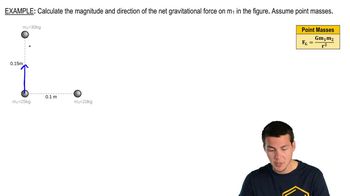
The gravitational force is an attractive force that acts between any two masses. It is described by Newton's law of universal gravitation, which states that the force is directly proportional to the product of the masses and inversely proportional to the square of the distance between their centers. The formula is F = G(m1*m2)/r^2, where G is the gravitational constant.
Recommended video:
Guided course
05:41
Gravitational Forces in 2D

Proton Mass

A proton is a subatomic particle found in the nucleus of an atom, carrying a positive charge. Its mass is approximately 1.67 x 10^-27 kg. In calculations involving gravitational force, the mass of the protons is essential, as it directly influences the magnitude of the gravitational force between them.
Recommended video:
Guided course
20:32
Mass Spectrometers

Distance in Force Calculations

In the context of gravitational force, the distance refers to the separation between the centers of the two masses. In this case, the distance is given as 2.0 femtometers (fm), which is 2.0 x 10^-15 meters. This distance is crucial for calculating the gravitational force, as it appears in the denominator of the gravitational force equation, affecting the overall force magnitude.
Recommended video:
Guided course
06:09
Work Done by a Constant Force