Ch 22: Electric Charges and Forces
Knight Calc - Physics for Scientists and Engineers 5th Edition
Knight Calc5th EditionPhysics for Scientists and EngineersISBN: 9780137344796Not the one you use?Change textbook
Chapter 22, Problem 9

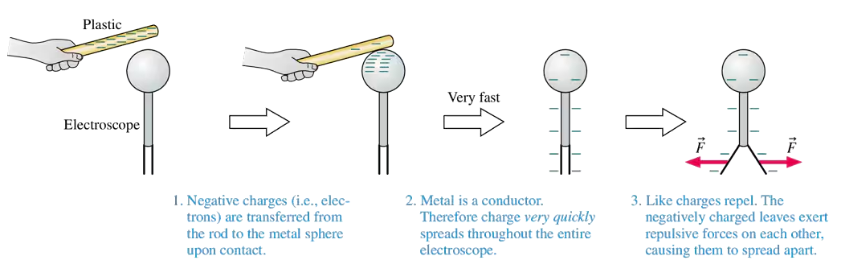
Figure 22.8 showed how an electroscope becomes negatively charged. The leaves will also repel each other if you touch the electroscope with a positively charged glass rod. Use a series of charge diagrams to explain what happens and why the leaves repel each other.

Verified step by step guidance
1
Start by understanding the concept of charging by conduction: When a positively charged object, such as a glass rod, touches a neutral electroscope, electrons from the electroscope are attracted to the positively charged rod and move toward it, leaving the electroscope with a net positive charge.
Draw a diagram of the initial state of the electroscope, showing it as neutral. Represent the positive and negative charges evenly distributed throughout the electroscope.
Next, illustrate the interaction when the positively charged glass rod touches the electroscope. Show electrons moving from the electroscope to the glass rod, leaving behind an excess of positive charges on the electroscope.
After the glass rod is removed, depict the electroscope with a net positive charge. The positive charges are now distributed across the electroscope, including the leaves.
Explain why the leaves repel each other: Since both leaves are positively charged, they experience a repulsive electrostatic force due to like charges repelling. This causes the leaves to move apart and stay separated.

Verified video answer for a similar problem:

This video solution was recommended by our tutors as helpful for the problem above.
Video duration:
3m
Was this helpful?

Key Concepts

Here are the essential concepts you must grasp in order to answer the question correctly.

Electrostatic Charge

Electrostatic charge refers to the physical property of matter that causes it to experience a force when placed in an electromagnetic field. Objects can be positively charged, negatively charged, or neutral, depending on the balance of protons and electrons. When a charged object comes into contact with a neutral object, it can transfer charge, leading to the charging of the neutral object.
Recommended video:
Guided course
06:36
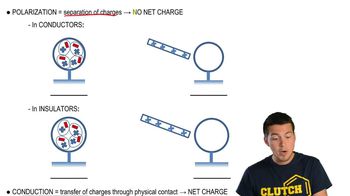
Charging Objects

Charge Induction

Charge induction is a process where a charged object influences the distribution of charges in a nearby neutral object without direct contact. For example, when a positively charged glass rod is brought near an electroscope, it causes electrons in the electroscope to move towards the rod, resulting in a temporary separation of charges. This leads to the leaves of the electroscope acquiring a net negative charge, which causes them to repel each other.
Recommended video:
Guided course
03:59
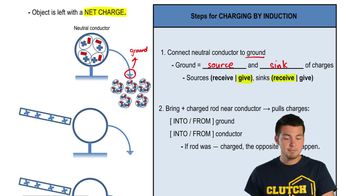
Charging By Induction

Coulomb's Law

Coulomb's Law describes the force between two charged objects, stating that the force is directly proportional to the product of the magnitudes of the charges and inversely proportional to the square of the distance between them. This law explains why like charges repel and opposite charges attract. In the case of the electroscope, the negatively charged leaves repel each other due to the electrostatic force described by Coulomb's Law.
Recommended video:
Guided course
09:52
Coulomb's Law