Ch 16: Traveling Waves
Knight Calc - Physics for Scientists and Engineers 5th Edition
Knight Calc5th EditionPhysics for Scientists and EngineersISBN: 9780137344796Not the one you use?Change textbook
Chapter 16, Problem 57

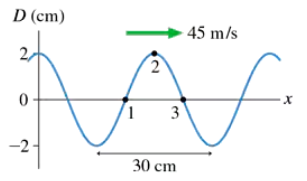
FIGURE P16.57 shows a snapshot graph of a wave traveling to the right along a string at 45 m/s. At this instant, what is the velocity of points 1, 2, and 3 on the string?

Verified step by step guidance
1
Step 1: Understand the problem. The wave is traveling to the right along the string at a speed of 45 m/s. The snapshot graph shows the displacement (D) of the string as a function of position (x). Points 1, 2, and 3 correspond to specific positions on the string. The goal is to determine the velocity of these points at the given instant.
Step 2: Recall the relationship between the velocity of a point on the string and the slope of the wave at that point. The velocity of a point on the string is proportional to the time derivative of the displacement, which can be related to the spatial derivative (slope) of the wave using the wave equation. The direction of the velocity depends on whether the slope is positive or negative.
Step 3: Analyze the graph. At point 1 (peak of the wave), the slope of the wave is zero, meaning the velocity of the string at this point is zero. At point 2 (zero crossing with a negative slope), the string is moving downward, and the velocity is negative. At point 3 (zero crossing with a positive slope), the string is moving upward, and the velocity is positive.
Step 4: Use the wave speed and the spatial derivative to calculate the velocity at each point. The wave speed (45 m/s) and the slope of the graph at each point can be used to determine the magnitude of the velocity. For point 1, the slope is zero, so the velocity is zero. For points 2 and 3, calculate the slope of the graph at these points to find the velocity magnitude.
Step 5: Summarize the results. Point 1 has zero velocity because it is at the peak of the wave. Point 2 has a negative velocity because the slope is negative at the zero crossing. Point 3 has a positive velocity because the slope is positive at the zero crossing. The exact magnitudes can be calculated using the slope values and the wave speed.

Verified video answer for a similar problem:

This video solution was recommended by our tutors as helpful for the problem above.
Video duration:
7m
Was this helpful?

Key Concepts

Here are the essential concepts you must grasp in order to answer the question correctly.

Wave Velocity

Wave velocity is the speed at which a wave propagates through a medium. In this case, the wave travels along a string at a specified speed, which affects how quickly points on the string oscillate. The wave velocity is determined by the properties of the medium and the type of wave, and it is crucial for understanding the motion of points along the wave.
Recommended video:
Guided course
03:48
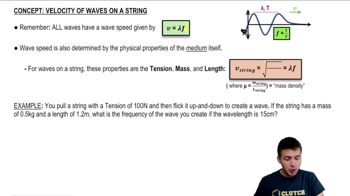
Velocity of Waves on a String

Transverse Waves

Transverse waves are waves in which the displacement of the medium is perpendicular to the direction of wave propagation. In the context of the string, as the wave travels, points on the string move up and down while the wave itself moves horizontally. Understanding the nature of transverse waves helps in analyzing the motion of specific points on the string.
Recommended video:
Guided course
07:32
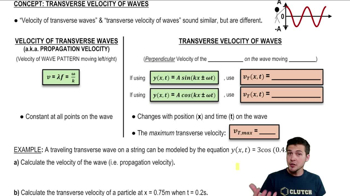
Transverse Velocity of Waves

Phase of a Wave

The phase of a wave refers to the position of a point in time on a wave cycle, which can be described in terms of angles or fractions of the wave's wavelength. Different points on the wave (like points 1, 2, and 3) can be at different phases, leading to varying velocities at those points. Recognizing the phase relationship is essential for determining the instantaneous velocity of points on the wave.
Recommended video:
Guided course
08:59
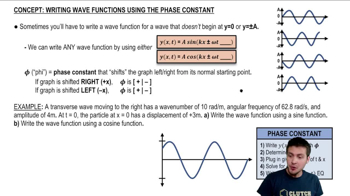
Phase Constant of a Wave Function
Related Practice
Textbook Question

A 1000 Hz sound wave traveling through 20°C air causes the pressure to oscillate around atmospheric pressure by ±0.050%. What is the maximum speed of an oscillating air molecule? Give your answer in mm/s.

1
views

Textbook Question

A 20.0-cm-long, 10.0-cm-diameter cylinder with a piston at one end contains 1.34 kg of an unknown liquid. Using the piston to compress the length of the liquid by 1.00 mm increases the pressure by 41.0 atm. What is the speed of sound in the liquid?

2
views
Textbook Question

A string that is under 50.0 N of tension has linear density 5.0 g/m. A sinusoidal wave with amplitude 3.0 cm and wavelength 2.0 m travels along the string. What is the maximum speed of a particle on the string?

1
views
Textbook Question

The string in FIGURE P16.59 has linear density μ. Find an expression in terms of M, μ, and θ for the speed of waves on the string.

5
views
Textbook Question

A sound wave is described by D(y,t)=(0.0200mm)×sin[(8.96rad/m)y+(3140rad/s)t+π/4rad]D(y, t) = (0.0200 \, \(\text{mm}\)) \(\times\) \(\sin\)[(8.96 \, \(\text{rad/m}\))y + (3140 \, \(\text{rad/s}\))t + \(\pi\)/4 \, \(\text{rad}\)], where yy is in mm and tt is in ss. Along which axis is the air oscillating?

15
views
Textbook Question

A wave on a string is described by D(x,t)=(2.00cm)×sin[(12.57rad/m)x(638rad/s)t]D(x,t) = (2.00 \, \(\text{cm}\)) \(\times\) \(\sin\)[(12.57 \, \(\text{rad/m}\))x - (638 \, \(\text{rad/s}\)) t], where xx is in mm and tt in ss. The linear density of the string is 5.00 g/m5.00\(\text{ g/m}\). What are The maximum speed of a point on the string?