Ch 16: Traveling Waves
Knight Calc - Physics for Scientists and Engineers 5th Edition
Knight Calc5th EditionPhysics for Scientists and EngineersISBN: 9780137344796Not the one you use?Change textbook
Chapter 16, Problem 17a

What is the frequency of an electromagnetic wave that has the same wavelength as a 2.5 kHz sound wave in water?

Verified step by step guidance
1
Step 1: Understand the problem. The goal is to find the frequency of an electromagnetic wave that has the same wavelength as a sound wave in water. The relationship between wavelength, frequency, and speed is given by the formula: v = fλ, where v is the speed, f is the frequency, and λ is the wavelength.
Step 2: Calculate the wavelength of the sound wave in water. Use the formula λ = v/f, where the speed of sound in water is approximately 1500 m/s and the frequency of the sound wave is 2.5 kHz (or 2500 Hz). Substitute these values into the formula to find the wavelength.
Step 3: Recognize that the electromagnetic wave has the same wavelength as the sound wave. The speed of electromagnetic waves in a vacuum (and approximately in air) is the speed of light, c = 3.0 × 10⁸ m/s. Use the formula f = c/λ to calculate the frequency of the electromagnetic wave.
Step 4: Substitute the wavelength calculated in Step 2 into the formula for the electromagnetic wave frequency. Use f = c/λ, where c is the speed of light and λ is the wavelength.
Step 5: Simplify the expression to find the frequency of the electromagnetic wave. Ensure units are consistent throughout the calculation (e.g., meters for wavelength and seconds for time). The result will give the frequency of the electromagnetic wave in Hz.

Verified video answer for a similar problem:

This video solution was recommended by our tutors as helpful for the problem above.
Was this helpful?

Key Concepts

Here are the essential concepts you must grasp in order to answer the question correctly.

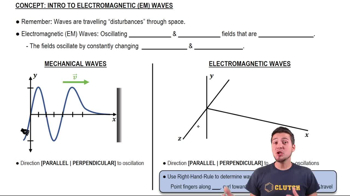
Electromagnetic Waves

Electromagnetic waves are oscillations of electric and magnetic fields that propagate through space. They travel at the speed of light in a vacuum and encompass a wide range of frequencies and wavelengths, including radio waves, microwaves, infrared, visible light, ultraviolet, X-rays, and gamma rays. The relationship between frequency and wavelength is fundamental to understanding their behavior.
Recommended video:
Guided course
05:22
Introduction to Electromagnetic (EM) Waves

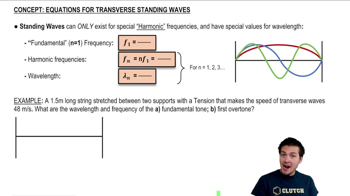
Wave Equation

The wave equation relates the speed of a wave to its frequency and wavelength, expressed as v = fλ, where v is the wave speed, f is the frequency, and λ is the wavelength. This equation is crucial for calculating the frequency of an electromagnetic wave when its wavelength is known. For electromagnetic waves in a vacuum, the speed is approximately 3 x 10^8 m/s.
Recommended video:
Guided course
06:28
Equations for Transverse Standing Waves

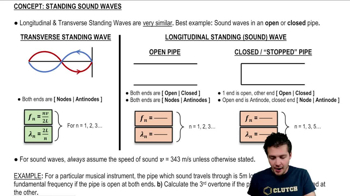
Sound Waves in Water

Sound waves are mechanical waves that require a medium to travel, such as air, water, or solids. In water, sound travels faster than in air due to the higher density and elasticity of the medium. The frequency of a sound wave, such as the 2.5 kHz mentioned, is related to its wavelength and speed in water, which is essential for comparing it to the frequency of an electromagnetic wave with the same wavelength.
Recommended video:
Guided course
05:17
Standing Sound Waves