Ch 16: Traveling Waves
Knight Calc - Physics for Scientists and Engineers 5th Edition
Knight Calc5th EditionPhysics for Scientists and EngineersISBN: 9780137344796Not the one you use?Change textbook
Chapter 16, Problem 22

A hammer taps on the end of a 4.00-m-long metal bar at room temperature. A microphone at the other end of the bar picks up two pulses of sound, one that travels through the metal and one that travels through the air. The pulses are separated in time by 9.00 ms. What is the speed of sound in this metal?

Verified step by step guidance
1
Step 1: Understand the problem. The sound pulse travels through two mediums: the metal bar and the air. The time difference between the two pulses is given as 9.00 ms. We need to calculate the speed of sound in the metal, given the length of the bar (4.00 m) and the speed of sound in air (approximately 343 m/s at room temperature).
Step 2: Calculate the time it takes for the sound to travel through the air. Use the formula for time: t=dv, where d is the distance (4.00 m) and v is the speed of sound in air (343 m/s).
Step 3: Let the speed of sound in the metal be vm. The time it takes for the sound to travel through the metal is given by tm=dvm. The time difference between the two pulses is given as 9.00 ms, so we can write the equation: tm=ta-9.00 ms.
Step 4: Substitute the expression for ta (time through air) and tm (time through metal) into the equation. This gives: dvm=dv-9.00 ms.
Step 5: Solve for vm (speed of sound in the metal). Rearrange the equation to isolate vm: vm=ddv-9.00. Substitute the known values for d and v to calculate the result.

Verified video answer for a similar problem:

This video solution was recommended by our tutors as helpful for the problem above.
Video duration:
3m
Was this helpful?

Key Concepts

Here are the essential concepts you must grasp in order to answer the question correctly.

Speed of Sound

The speed of sound is the distance traveled per unit of time by a sound wave as it propagates through a medium. It varies depending on the medium's properties, such as density and elasticity. In solids, sound travels faster than in liquids and gases due to closer molecular spacing and stronger intermolecular forces.
Recommended video:
Guided course
05:17
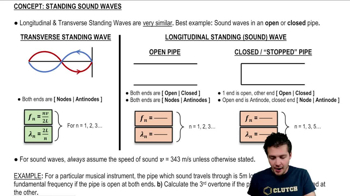
Standing Sound Waves

Wave Propagation

Wave propagation refers to the movement of sound waves through different media. In this scenario, sound travels through both a metal bar and air, each with distinct speeds. The time difference between the two sound pulses allows for the calculation of the speed of sound in the metal by considering the distance and the time delay.
Recommended video:
Guided course
07:32
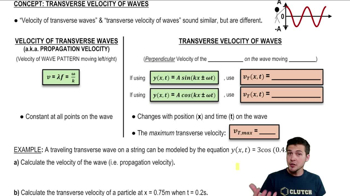
Transverse Velocity of Waves

Time Delay

Time delay in this context is the difference in arrival times of sound waves traveling through different media. The problem states that the sound pulse through the metal arrives 9.00 ms before the pulse through the air. This time delay is crucial for calculating the speed of sound in the metal by using the known distance and the time difference.
Recommended video:
Guided course
05:59
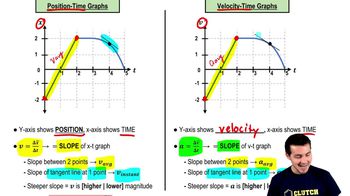
Velocity-Time Graphs & Acceleration