Ch 16: Traveling Waves
Knight Calc - Physics for Scientists and Engineers 5th Edition
Knight Calc5th EditionPhysics for Scientists and EngineersISBN: 9780137344796Not the one you use?Change textbook
Chapter 16, Problem 8

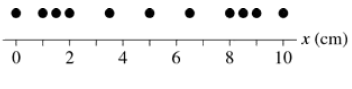
FIGURE EX16.8 is a picture at t = 0 s of the particles in a medium as a longitudinal wave is passing through. The equilibrium spacing between the particles is 1.0 cm. Draw the snapshot graph D(x, t = 0 s) of this wave at t = 0 s.

Verified step by step guidance
1
Step 1: Observe the image provided. The red squares represent particles in a medium, and their positions indicate the compression and rarefaction regions of a longitudinal wave. The equilibrium spacing between particles is 1.0 cm.
Step 2: Identify the regions of compression and rarefaction. Compression occurs where particles are closer together than the equilibrium spacing, and rarefaction occurs where particles are farther apart than the equilibrium spacing.
Step 3: To draw the snapshot graph D(x, t = 0 s), plot the displacement of particles (D) as a function of position (x). Displacement is positive for particles displaced to the right of their equilibrium position and negative for particles displaced to the left.
Step 4: Analyze the positions of the particles in the image. For example, at x = 16 cm, particles are compressed, indicating a peak in the graph. At x = 10 cm, particles are rarefied, indicating a trough in the graph.
Step 5: Sketch the graph by connecting the peaks and troughs smoothly to represent the wave. Ensure the graph reflects the periodic nature of the wave, with alternating regions of compression and rarefaction.

Verified video answer for a similar problem:

This video solution was recommended by our tutors as helpful for the problem above.
Video duration:
3m
Was this helpful?

Key Concepts

Here are the essential concepts you must grasp in order to answer the question correctly.

Longitudinal Waves

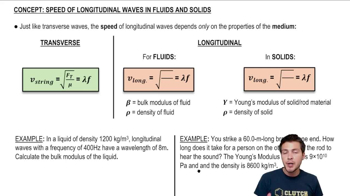
Longitudinal waves are a type of mechanical wave where the particle displacement is parallel to the direction of wave propagation. In these waves, particles in the medium oscillate back and forth along the same line as the wave travels, creating regions of compression and rarefaction. This is in contrast to transverse waves, where particle displacement is perpendicular to wave direction.
Recommended video:
Guided course
05:40
Speed of Longitudinal Waves (Fluids & Solids)

Equilibrium Spacing

Equilibrium spacing refers to the natural distance between particles in a medium when no wave is passing through. In the context of longitudinal waves, this spacing is crucial for understanding how particles compress and expand as the wave moves. The given equilibrium spacing of 1.0 cm indicates the distance between adjacent particles when they are at rest, which helps in visualizing the wave's effect on the medium.
Recommended video:
Guided course
10:13
Torque & Equilibrium

Snapshot Graph

A snapshot graph represents the position of particles in a medium at a specific moment in time, illustrating the wave's effect. For longitudinal waves, this graph typically shows the compressions and rarefactions of particles along the medium. At t = 0 s, the graph will depict the arrangement of particles based on their displacement from the equilibrium position, allowing for a visual understanding of the wave's characteristics.
Recommended video:
Guided course
07:32
Graphing Position, Velocity, and Acceleration Graphs