Ch 16: Traveling Waves
Knight Calc - Physics for Scientists and Engineers 5th Edition
Knight Calc5th EditionPhysics for Scientists and EngineersISBN: 9780137344796Not the one you use?Change textbook
Chapter 16, Problem 4

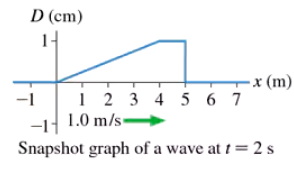
Draw the history graph D(x = 4.0 m, t) at x = 4.0 m for the wave shown in FIGURE EX16.4.

Verified step by step guidance
1
Step 1: Understand the problem. The snapshot graph provided shows the displacement of a wave as a function of position at t = 0 s. The goal is to draw the history graph D(x = 4.0 m, t), which represents the displacement of the wave at x = 4.0 m as a function of time.
Step 2: Analyze the snapshot graph. At x = 4.0 m, the displacement at t = 0 s is approximately -5 mm. The wave is moving to the right with a velocity v = 4.0 m/s. This means the wave's shape will shift to the right as time progresses.
Step 3: Determine the time it takes for different features of the wave to pass through x = 4.0 m. For example, the peak of the wave (at x = 5.0 m) will reach x = 4.0 m after a time interval Δt = (x_peak - x_observed) / v = (5.0 m - 4.0 m) / 4.0 m/s = 0.25 s.
Step 4: Use the snapshot graph to track the displacement at x = 4.0 m over time. As the wave moves to the right, the displacement at x = 4.0 m will follow the same pattern as the snapshot graph, but shifted in time. For example, the displacement will start at -5 mm at t = 0 s, then increase to 0 mm at t = 0.25 s, reach 2 mm at t = 0.5 s, and so on.
Step 5: Plot the history graph. On the graph, the x-axis will represent time (t), and the y-axis will represent displacement (D). Use the information from the snapshot graph and the calculated time intervals to plot the displacement at x = 4.0 m as a function of time. The graph will resemble the shape of the snapshot graph but flipped to show how displacement changes over time at the fixed position x = 4.0 m.

Verified video answer for a similar problem:

This video solution was recommended by our tutors as helpful for the problem above.
Video duration:
3m
Was this helpful?

Key Concepts

Here are the essential concepts you must grasp in order to answer the question correctly.

Wave Properties

Waves are disturbances that transfer energy through a medium without the permanent displacement of particles. Key properties include wavelength, frequency, amplitude, and speed. Understanding these properties is essential for analyzing wave behavior, including how they propagate and interact with boundaries.
Recommended video:
Guided course
06:32
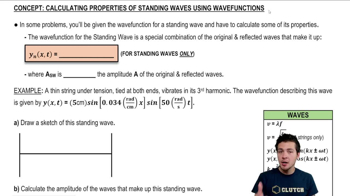
Properties of Standing Waves from Wave Functions

History Graphs

A history graph represents the variation of a wave's displacement at a fixed position over time. It is useful for visualizing how the wave evolves, showing peaks and troughs as they pass through a specific point. This concept is crucial for interpreting wave dynamics and understanding temporal changes in wave behavior.
Recommended video:
Guided course
07:32
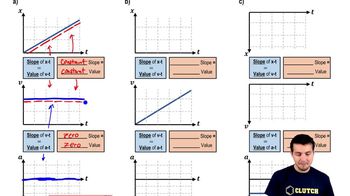
Graphing Position, Velocity, and Acceleration Graphs

Snapshot vs. History Graphs

Snapshot graphs depict the wave's displacement at a specific moment in time across various positions, while history graphs show how displacement changes at a single position over time. Recognizing the difference between these two types of graphs is vital for accurately analyzing wave phenomena and predicting future states of the wave.
Recommended video:
Guided course
07:32
Graphing Position, Velocity, and Acceleration Graphs