
Ch. 29 - Electromagnetic Induction and Faraday's Law
Giancoli Douglas - Physics for Scientists and Engineers 5th edition
Giancoli Douglas5th editionPhysics for Scientists and EngineersISBN: 9780137488179Not the one you use?Change textbook
Chapter 28, Problem 52

(II) For the electric power transmission system shown in Fig. 29–26, what is the ratio Ns/Np for (a) the step-up transformer, (b) the step-down transformer next to the home?

Verified step by step guidance
1
Understand the problem: The question involves determining the ratio of turns (Nₛ/Nₚ) for two transformers in an electric power transmission system. Transformers work based on the principle of electromagnetic induction, where the ratio of the secondary voltage (Vₛ) to the primary voltage (Vₚ) is equal to the ratio of the number of turns in the secondary coil (Nₛ) to the number of turns in the primary coil (Nₚ). This can be expressed as: NsNp = VsVp.
For part (a), the step-up transformer increases the voltage from the power plant to the high-voltage transmission lines. Identify the primary voltage (Vₚ) and the secondary voltage (Vₛ) from the problem or figure. Use the formula: NsNp = VsVp. Substitute the given values for Vₛ and Vₚ to find the ratio Nₛ/Nₚ for the step-up transformer.
For part (b), the step-down transformer reduces the voltage from the transmission lines to a lower voltage suitable for home use. Again, identify the primary voltage (Vₚ) and the secondary voltage (Vₛ) from the problem or figure. Use the same formula: NsNp = VsVp. Substitute the given values for Vₛ and Vₚ to find the ratio Nₛ/Nₚ for the step-down transformer.
Verify the units and ensure that the voltages are consistent (e.g., both in volts). If necessary, convert the units to match before substituting into the formula.
Summarize the results: The calculated ratios Nₛ/Nₚ for both the step-up and step-down transformers provide the required information about the number of turns in the secondary and primary coils for each transformer. These ratios are crucial for understanding how the transformers adjust voltage levels in the power transmission system.

Verified video answer for a similar problem:

This video solution was recommended by our tutors as helpful for the problem above.
Video duration:
5m
Was this helpful?

Key Concepts

Here are the essential concepts you must grasp in order to answer the question correctly.

Transformers

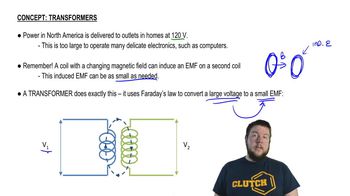
Transformers are electrical devices that transfer electrical energy between two or more circuits through electromagnetic induction. They consist of primary and secondary coils, where the voltage is increased (step-up transformer) or decreased (step-down transformer) based on the turns ratio of the coils. This principle is crucial for efficient power transmission over long distances.
Recommended video:

Turns Ratio

The turns ratio of a transformer is the ratio of the number of turns in the primary coil (Nₚ) to the number of turns in the secondary coil (Nₛ). This ratio determines how the voltage changes between the primary and secondary sides. For a step-up transformer, Nₛ/Nₚ is greater than 1, while for a step-down transformer, it is less than 1.
Recommended video:
Guided course
05:32
Ratio of energies of cylinder on surface

Voltage and Power Relationships

In transformers, the relationship between voltage and power is governed by the equation P₁ = P₂, where P represents power. This means that the power input to the primary coil equals the power output from the secondary coil, assuming no losses. Consequently, the voltage and current are inversely related, allowing for efficient energy transfer while maintaining power conservation.
Recommended video:
Related Practice
Textbook Question

Neon signs require 12 kV for their operation. To operate from a 240-V line, what must be the ratio of secondary to primary turns of the transformer? What would the voltage output be if the transformer were connected in reverse?

1
views
Textbook Question

If 75 MW of power at 45 kV (rms) arrives at a town from a generator via transmission lines of total resistance 3.0 Ω, calculate (a) the emf at the generator end of the lines, and (b) the fraction of the power generated that is wasted in the lines.

1
views
Textbook Question

The primary windings of a transformer which has an 85% efficiency are connected to 110-V ac. The secondary windings are connected across a 2.4-Ω, 75-W lightbulb.

(a) Calculate the current through the primary windings of the transformer.

(b) Calculate the ratio of the number of primary windings of the transformer to the number of secondary windings of the transformer.

1
views
Textbook Question

A model-train transformer plugs into 120-V ac and draws 0.35 A while supplying 6.5 A to the train.

(a) What voltage is present across the tracks?

(b) Is the transformer step-up or step-down?

2
views
Textbook Question

(III) In a circular region, there is a uniform magnetic field B\(\overrightarrow{B}\) pointing into the page (Fig. 29–56). An xy coordinate system has its origin at the circular region’s center. A free positive point charge +Q = 1.0 μC is initially at rest at a position x = +10 cm on the x axis. If the magnitude of the magnetic field is now decreased at a rate of -0.10 T/s, what force (magnitude and direction) will act on +Q?


1
views
Textbook Question

A circular loop of area 12 m² encloses a magnetic field perpendicular to the plane of the loop; its magnitude is B(t) = (8.0 T/s)t. The loop is connected to a 7.5-Ω resistor and a 6.5-pF capacitor in series. When fully charged, how much charge is stored on the capacitor?

1
views