Ch. 29 - Electromagnetic Induction and Faraday's Law
Giancoli Douglas - Physics for Scientists and Engineers 5th edition
Giancoli Douglas5th editionPhysics for Scientists and EngineersISBN: 9780137488179Not the one you use?Change textbook
Chapter 28, Problem 47

Neon signs require 12 kV for their operation. To operate from a 240-V line, what must be the ratio of secondary to primary turns of the transformer? What would the voltage output be if the transformer were connected in reverse?

Verified step by step guidance
1
Step 1: Understand the problem. A transformer is used to step up or step down voltage. The ratio of secondary to primary turns determines the voltage transformation. The formula for the voltage ratio is \( \frac{V_s}{V_p} = \frac{N_s}{N_p} \), where \( V_s \) and \( V_p \) are the secondary and primary voltages, and \( N_s \) and \( N_p \) are the secondary and primary turns.
Step 2: Identify the given values. The primary voltage \( V_p \) is 240 V, and the secondary voltage \( V_s \) is 12 kV (12,000 V). Substitute these values into the formula \( \frac{V_s}{V_p} = \frac{N_s}{N_p} \) to find the ratio of secondary to primary turns.
Step 3: Rearrange the formula to solve for the turns ratio: \( \frac{N_s}{N_p} = \frac{V_s}{V_p} \). Substitute \( V_s = 12,000 \, \text{V} \) and \( V_p = 240 \, \text{V} \) into the equation.
Step 4: To determine the voltage output if the transformer is connected in reverse, reverse the roles of \( V_s \) and \( V_p \). Use the same turns ratio \( \frac{N_s}{N_p} \) to calculate the new secondary voltage when the primary voltage is 12 kV.
Step 5: Substitute \( V_p = 12,000 \, \text{V} \) and the calculated turns ratio into the formula \( V_s = V_p \times \frac{N_p}{N_s} \) to find the reversed secondary voltage. This step completes the problem-solving process.

Verified video answer for a similar problem:

This video solution was recommended by our tutors as helpful for the problem above.
Video duration:
4m
Was this helpful?

Key Concepts

Here are the essential concepts you must grasp in order to answer the question correctly.

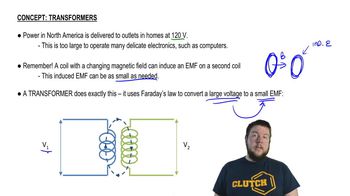
Transformer Basics

A transformer is an electrical device that transfers electrical energy between two or more circuits through electromagnetic induction. It consists of primary and secondary coils, where the voltage is transformed based on the turns ratio of these coils. The relationship between the primary voltage (input) and secondary voltage (output) is given by the formula Vp/Vs = Np/Ns, where V is voltage and N is the number of turns in the coils.
Recommended video:

Turns Ratio

The turns ratio of a transformer is the ratio of the number of turns in the primary coil to the number of turns in the secondary coil. This ratio determines how the voltage is stepped up or stepped down. For example, if the turns ratio is greater than one, the transformer steps down the voltage; if it is less than one, it steps up the voltage. In this case, to find the required turns ratio for a 12 kV output from a 240 V input, the ratio can be calculated as 12,000 V / 240 V.
Recommended video:
Guided course
05:32
Ratio of energies of cylinder on surface

Reverse Connection of Transformer

When a transformer is connected in reverse, the primary and secondary roles are swapped, meaning the secondary coil becomes the input and the primary coil becomes the output. This configuration can be used to step down the voltage from a higher level to a lower level. The output voltage in this case can be calculated using the same turns ratio, but it will yield a lower voltage than the original primary input, demonstrating the principle of energy conservation in transformers.
Recommended video: