
Ch. 29 - Electromagnetic Induction and Faraday's Law
Giancoli Douglas - Physics for Scientists and Engineers 5th edition
Giancoli Douglas5th editionPhysics for Scientists and EngineersISBN: 9780137488179Not the one you use?Change textbook
Chapter 28, Problem 46

A transformer has 680 turns in the primary coil and 85 in the secondary coil. What kind of transformer is this, and by what factor does it change the voltage? By what factor does it change the current?

Verified step by step guidance
1
Identify the type of transformer by comparing the number of turns in the primary coil (Nₚ = 680) and the secondary coil (Nₛ = 85). Since Nₚ > Nₛ, this is a step-down transformer.
Use the turns ratio formula to determine the voltage change factor: \( \text{Voltage Ratio} = \frac{Nₚ}{Nₛ} \). Substitute \( Nₚ = 680 \) and \( Nₛ = 85 \) into the formula.
Recognize that the current in a transformer is inversely proportional to the voltage. Use the current ratio formula: \( \text{Current Ratio} = \frac{Nₛ}{Nₚ} \). Substitute \( Nₛ = 85 \) and \( Nₚ = 680 \) into the formula.
Conclude that the transformer decreases the voltage by the factor calculated in step 2 and increases the current by the factor calculated in step 3.
Verify the conservation of power principle: \( P_{\text{primary}} = P_{\text{secondary}} \), where \( P = V \cdot I \), to ensure the calculations align with the physical behavior of transformers.

Verified video answer for a similar problem:

This video solution was recommended by our tutors as helpful for the problem above.
Video duration:
6m
Was this helpful?

Key Concepts

Here are the essential concepts you must grasp in order to answer the question correctly.

Transformer Basics

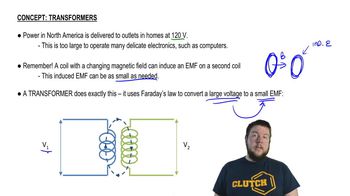
A transformer is an electrical device that transfers electrical energy between two or more circuits through electromagnetic induction. It consists of primary and secondary coils, where the primary coil receives input voltage and the secondary coil delivers output voltage. The ratio of the number of turns in the coils determines whether the transformer steps up or steps down the voltage.
Recommended video:

Turns Ratio

The turns ratio of a transformer is the ratio of the number of turns in the primary coil to the number of turns in the secondary coil. It is crucial for determining how the voltage and current change between the primary and secondary sides. For a transformer with 'N1' turns in the primary and 'N2' turns in the secondary, the voltage change factor is given by V2/V1 = N2/N1, and the current change factor is I2/I1 = N1/N2.
Recommended video:
Guided course
05:32
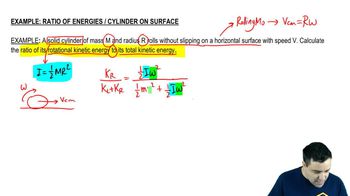
Ratio of energies of cylinder on surface

Voltage and Current Transformation

In a transformer, when the voltage is stepped up (increased), the current is stepped down (decreased), and vice versa. This relationship is governed by the conservation of energy principle, which states that the power input to the primary coil (P1 = V1 * I1) must equal the power output from the secondary coil (P2 = V2 * I2), assuming no losses. Thus, the product of voltage and current remains constant across the transformer.
Recommended video:
Guided course
07:14
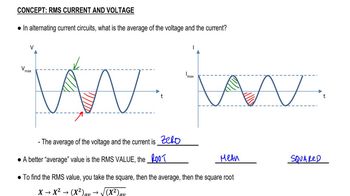
RMS Current and Voltage
Related Practice
Textbook Question

(III) Suppose a conducting rod (mass m, resistance R) rests on two frictionless and resistanceless parallel rails a distance ℓ apart in a uniform magnetic field B\(\overrightarrow{B}\) (⊥ to the rails and to the rod) as in Fig. 29–53. At t = 0, the rod is at rest and a source of emf is connected to the points a and b. Determine the speed of the rod as a function of time if (a) the source puts out a constant current I, (b) the source puts out a constant emf ε₀. (c) Does the rod reach a terminal speed in either case? If so, what is it?

1
views
Textbook Question

Neon signs require 12 kV for their operation. To operate from a 240-V line, what must be the ratio of secondary to primary turns of the transformer? What would the voltage output be if the transformer were connected in reverse?

1
views
Textbook Question

If 75 MW of power at 45 kV (rms) arrives at a town from a generator via transmission lines of total resistance 3.0 Ω, calculate (a) the emf at the generator end of the lines, and (b) the fraction of the power generated that is wasted in the lines.

1
views
Textbook Question

A model-train transformer plugs into 120-V ac and draws 0.35 A while supplying 6.5 A to the train.

(a) What voltage is present across the tracks?

(b) Is the transformer step-up or step-down?

2
views
Textbook Question

(II) A conducting rod rests on two long frictionless parallel rails in a magnetic field B\(\overrightarrow{B}\) (⊥ to the rails and rod) as in Fig. 29–53. (a) If the rails are horizontal and the rod is given an initial push, will the rod travel at constant speed even though a magnetic field is present? (b) Suppose at t = 0, when the rod has speed v = v0, the two rails are connected electrically by a wire from point a to point b. Assuming the rod has resistance R and the rails have negligible resistance, determine the speed of the rod as a function of time. Discuss your answer.

3
views