Ch 11: Impulse and Momentum
Knight Calc - Physics for Scientists and Engineers 5th Edition
Knight Calc5th EditionPhysics for Scientists and EngineersISBN: 9780137344796Not the one you use?Change textbook
Chapter 11, Problem 11b

A force in the +x-direction increases linearly from 0 N to 9000 N in 5.0 s, then suddenly ends. What impulse does this force provide?

Verified step by step guidance
1
Step 1: Recall the definition of impulse. Impulse is the product of force and the time interval during which the force acts. Mathematically, impulse is given by \( J = \int F(t) \, dt \), where \( F(t) \) is the force as a function of time.
Step 2: Recognize that the force increases linearly from 0 N to 9000 N over 5.0 s. A linear force can be expressed as \( F(t) = kt \), where \( k \) is the slope of the force-time graph. Determine \( k \) using the formula \( k = \frac{F_{\text{max}}}{t_{\text{max}}} \), where \( F_{\text{max}} = 9000 \, \text{N} \) and \( t_{\text{max}} = 5.0 \, \text{s} \).
Step 3: Substitute \( F(t) = kt \) into the impulse formula \( J = \int F(t) \, dt \). The integral becomes \( J = \int_{0}^{5.0} kt \, dt \). Evaluate the integral by substituting \( k \) and solving \( \int_{0}^{5.0} kt \, dt = k \int_{0}^{5.0} t \, dt \).
Step 4: Compute the integral \( \int_{0}^{5.0} t \, dt \), which is \( \frac{1}{2} t^2 \) evaluated from \( t = 0 \) to \( t = 5.0 \). Substitute the limits of integration to find the result of the integral.
Step 5: Multiply the result of the integral by \( k \) to find the total impulse \( J \). The impulse is the area under the force-time graph, which corresponds to the triangular region formed by the linear increase of force.

Verified video answer for a similar problem:

This video solution was recommended by our tutors as helpful for the problem above.
Video duration:
2m
Was this helpful?

Key Concepts

Here are the essential concepts you must grasp in order to answer the question correctly.

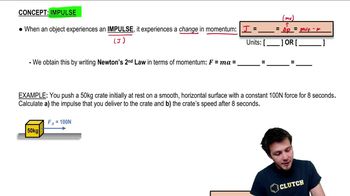
Impulse

Impulse is defined as the change in momentum of an object when a force is applied over a period of time. It is mathematically represented as the product of the average force and the time duration during which the force acts. In this scenario, the impulse can be calculated by integrating the force over the time interval, which gives the total effect of the force on the object's momentum.
Recommended video:
Guided course
06:00
Impulse & Impulse-Momentum Theorem

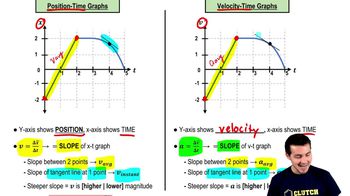
Force-Time Graph

A force-time graph visually represents how a force varies with time. In this case, the force increases linearly from 0 N to 9000 N over 5 seconds, forming a triangular shape on the graph. The area under the force-time graph corresponds to the impulse delivered to the object, which can be calculated using the formula for the area of a triangle: 1/2 * base * height.
Recommended video:
Guided course
05:59
Velocity-Time Graphs & Acceleration

Linear Increase

A linear increase refers to a steady, uniform change in a quantity over time, represented by a straight line on a graph. In this problem, the force increases linearly, meaning it rises at a constant rate from 0 N to 9000 N over 5 seconds. This characteristic simplifies the calculation of impulse, as the average force can be easily determined by taking the midpoint of the initial and final values.
Recommended video:
Guided course
07:31
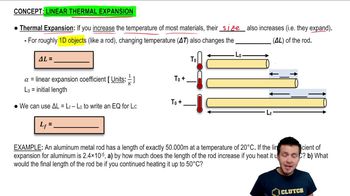
Linear Thermal Expansion