Ch 05: Force and Motion
Knight Calc - Physics for Scientists and Engineers 5th Edition
Knight Calc5th EditionPhysics for Scientists and EngineersISBN: 9780137344796Not the one you use?Change textbook
Chapter 5, Problem 56a

A rubber ball bounces. We'd like to understand how the ball bounces. A rubber ball has been dropped and is bouncing off the floor. Draw a motion diagram of the ball during the brief time interval that it is in contact with the floor. Show 4 or 5 frames as the ball compresses, then another 4 or 5 frames as it expands. What is the direction of a during each of these parts of the motion?

Verified step by step guidance
1
Step 1: Understand the motion of the ball. When the ball is dropped, it accelerates downward due to gravity. Upon hitting the floor, the ball compresses as it decelerates to a stop momentarily. Then, it expands as it rebounds upward. The motion diagram will represent these phases: compression and expansion.
Step 2: During the compression phase (as the ball is in contact with the floor and compressing), the acceleration vector points upward. This is because the floor exerts an upward force on the ball, opposing its downward motion and decelerating it.
Step 3: During the expansion phase (as the ball is in contact with the floor and expanding), the acceleration vector still points upward. This is because the floor continues to exert an upward force, now propelling the ball upward.
Step 4: To draw the motion diagram, represent the ball's position at equal time intervals. For the compression phase, the spacing between the positions will decrease as the ball slows down. For the expansion phase, the spacing will increase as the ball speeds up. Use arrows to indicate the direction of acceleration (upward) during both phases.
Step 5: Label the diagram clearly to show the compression and expansion phases, and indicate the direction of acceleration (a) during each phase. This will help visualize how the ball's motion changes while in contact with the floor.

Verified video answer for a similar problem:

This video solution was recommended by our tutors as helpful for the problem above.
Video duration:
4m
Was this helpful?

Key Concepts

Here are the essential concepts you must grasp in order to answer the question correctly.

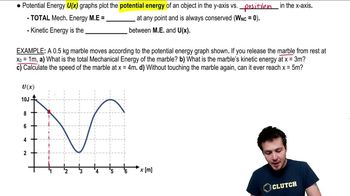
Elastic Potential Energy

When a rubber ball is compressed upon impact with the floor, it stores elastic potential energy. This energy is a result of the deformation of the ball's material, which allows it to return to its original shape. The amount of energy stored depends on the degree of compression and the material properties of the ball.
Recommended video:
Guided course
07:24
Potential Energy Graphs

Newton's Third Law of Motion

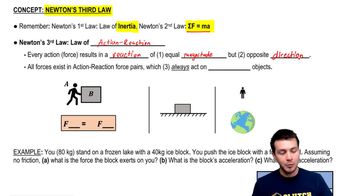
Newton's Third Law states that for every action, there is an equal and opposite reaction. When the ball hits the floor, it exerts a force on the floor, and the floor exerts an equal force back on the ball. This reaction force is what causes the ball to bounce back up after it compresses.
Recommended video:
Guided course
08:01
Newton's Third Law & Action-Reaction Pairs

Acceleration During Bouncing

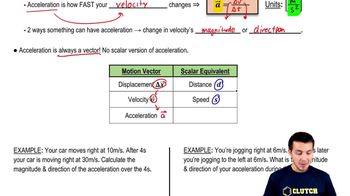
During the contact with the floor, the ball experiences acceleration due to the forces acting on it. When compressing, the acceleration is directed downward as gravity pulls it down, while during expansion, the acceleration is directed upward as the ball pushes off the floor. Understanding the direction and magnitude of these accelerations is crucial for analyzing the motion of the ball.
Recommended video:
Guided course
05:47
Intro to Acceleration
Related Practice
Textbook Question

A rubber ball bounces. We'd like to understand how the ball bounces. Draw a free-body diagram of the ball during its contact with the ground. Is there a net force acting on the ball? If so, in which direction?

2
views

Textbook Question

Problems 42, 43, 44, 45, 46, 47, 48, 49, 50, 51, and 52 describe a situation. For each, draw a motion diagram, a force-identification diagram, and a free-body diagram. A model rocket is fired straight down from the top of a tower.

11
views
Textbook Question

If a car stops suddenly, you feel 'thrown forward.' We'd like to understand what happens to the passengers as a car stops. Imagine yourself sitting on a very slippery bench inside a car. This bench has no friction, no seat back, and there's nothing for you to hold onto. Draw your free-body diagram. Is there a net force on you? If so, in which direction?

1
views
Textbook Question

Problems 42, 43, 44, 45, 46, 47, 48, 49, 50, 51, and 52 describe a situation. For each, draw a motion diagram, a force-identification diagram, and a free-body diagram. A rocket is being launched straight up. Air resistance is not negligible.

3
views
Textbook Question

Problems 42, 43, 44, 45, 46, 47, 48, 49, 50, 51, and 52 describe a situation. For each, draw a motion diagram, a force-identification diagram, and a free-body diagram. A Styrofoam ball has just been shot straight up. Air resistance is not negligible.

2
views
Textbook Question

If a car stops suddenly, you feel 'thrown forward.' We'd like to understand what happens to the passengers as a car stops. Imagine yourself sitting on a very slippery bench inside a car. This bench has no friction, no seat back, and there's nothing for you to hold onto. Describe what happens to you as the car slows down.

1
views