
Ch 05: Force and Motion
Knight Calc - Physics for Scientists and Engineers 5th Edition
Knight Calc5th EditionPhysics for Scientists and EngineersISBN: 9780137344796Not the one you use?Change textbook
Chapter 5, Problem 56c

A rubber ball bounces. We'd like to understand how the ball bounces. Draw a free-body diagram of the ball during its contact with the ground. Is there a net force acting on the ball? If so, in which direction?

Verified step by step guidance
1
Step 1: Begin by understanding the scenario. When the rubber ball is in contact with the ground, forces are acting on it. The key forces to consider are the gravitational force acting downward and the normal force exerted by the ground acting upward.
Step 2: Draw the free-body diagram. Represent the ball as a dot or a small circle. Draw an arrow pointing downward labeled as 'F_gravity' to represent the gravitational force. Then, draw an arrow pointing upward labeled as 'F_normal' to represent the normal force exerted by the ground.
Step 3: Analyze the net force. During the ball's contact with the ground, the normal force is greater than the gravitational force because the ground is exerting an additional upward force to reverse the ball's motion. This results in a net upward force.
Step 4: Explain the direction of the net force. The net force acts upward during the contact with the ground, which is responsible for accelerating the ball upward and causing it to bounce.
Step 5: Conclude the analysis. The free-body diagram shows the forces acting on the ball, and the net force is upward during the contact with the ground. This upward net force is what allows the ball to bounce back into the air.

Verified video answer for a similar problem:

This video solution was recommended by our tutors as helpful for the problem above.
Video duration:
4m
Was this helpful?

Key Concepts

Here are the essential concepts you must grasp in order to answer the question correctly.

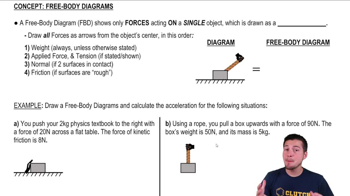
Free-Body Diagram

A free-body diagram is a graphical representation used to visualize the forces acting on an object. In the case of the rubber ball, the diagram would illustrate all the forces, such as gravity and the normal force from the ground, acting on the ball during its contact with the surface. This helps in analyzing the net force and the resulting motion of the object.
Recommended video:
Guided course
08:42
Free-Body Diagrams

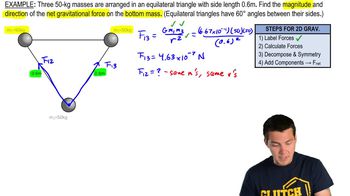
Net Force

Net force is the vector sum of all the forces acting on an object. It determines the object's acceleration according to Newton's second law of motion. In the context of the bouncing ball, if the forces are unbalanced, a net force will act on the ball, influencing its motion and determining whether it accelerates upwards or downwards.
Recommended video:
Guided course
06:28
Finding Net Forces in 2D Gravitation

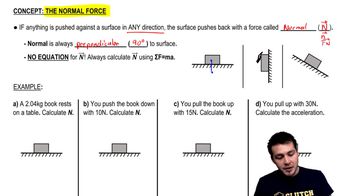
Normal Force

The normal force is the support force exerted by a surface perpendicular to the object in contact with it. For the rubber ball, when it contacts the ground, the normal force acts upward, counteracting the downward force of gravity. This interaction is crucial for understanding how the ball bounces back after hitting the ground.
Recommended video:
Guided course
08:17
The Normal Force
Related Practice
Textbook Question

Problems 42, 43, 44, 45, 46, 47, 48, 49, 50, 51, and 52 describe a situation. For each, draw a motion diagram, a force-identification diagram, and a free-body diagram. A model rocket is fired straight down from the top of a tower.

11
views
Textbook Question

A rubber ball bounces. We'd like to understand how the ball bounces. A rubber ball has been dropped and is bouncing off the floor. Draw a motion diagram of the ball during the brief time interval that it is in contact with the floor. Show 4 or 5 frames as the ball compresses, then another 4 or 5 frames as it expands. What is the direction of a during each of these parts of the motion?

2
views
Textbook Question

If a car stops suddenly, you feel 'thrown forward.' We'd like to understand what happens to the passengers as a car stops. Imagine yourself sitting on a very slippery bench inside a car. This bench has no friction, no seat back, and there's nothing for you to hold onto. Draw your free-body diagram. Is there a net force on you? If so, in which direction?

1
views
Textbook Question

Problems 42, 43, 44, 45, 46, 47, 48, 49, 50, 51, and 52 describe a situation. For each, draw a motion diagram, a force-identification diagram, and a free-body diagram. A rocket is being launched straight up. Air resistance is not negligible.

3
views
Textbook Question

If a car stops suddenly, you feel 'thrown forward.' We'd like to understand what happens to the passengers as a car stops. Imagine yourself sitting on a very slippery bench inside a car. This bench has no friction, no seat back, and there's nothing for you to hold onto. Describe what happens to you as the car slows down.

1
views