
Ch 05: Force and Motion
Knight Calc - Physics for Scientists and Engineers 5th Edition
Knight Calc5th EditionPhysics for Scientists and EngineersISBN: 9780137344796Not the one you use?Change textbook
Chapter 5, Problem 42

Problems 42, 43, 44, 45, 46, 47, 48, 49, 50, 51, and 52 describe a situation. For each, draw a motion diagram, a force-identification diagram, and a free-body diagram. A Styrofoam ball has just been shot straight up. Air resistance is not negligible.

Verified step by step guidance
1
Analyze the situation: The Styrofoam ball is moving upward after being shot, and air resistance is acting against its motion. Gravity is also acting downward. These forces will influence the motion of the ball.
Draw the motion diagram: Represent the ball's upward motion with a series of dots. The spacing between the dots should decrease as the ball slows down due to the opposing forces (gravity and air resistance). This shows deceleration.
Create the force-identification diagram: Identify all forces acting on the ball. These include the gravitational force (weight) acting downward and the air resistance force acting downward as well (opposing the upward motion).
Draw the free-body diagram: Represent the ball as a dot. Draw a downward arrow labeled \( F_g \) (gravitational force) and another downward arrow labeled \( F_{air} \) (air resistance). Ensure the lengths of the arrows reflect the relative magnitudes of the forces, with \( F_g \) typically larger than \( F_{air} \).
Summarize the dynamics: The net force on the ball is downward because both gravity and air resistance act in the same direction. This net force causes the ball to decelerate as it moves upward.

Verified video answer for a similar problem:

This video solution was recommended by our tutors as helpful for the problem above.
Video duration:
3m
Was this helpful?

Key Concepts

Here are the essential concepts you must grasp in order to answer the question correctly.

Motion Diagrams

A motion diagram visually represents the position of an object at various time intervals, illustrating its trajectory and changes in velocity. In the context of the Styrofoam ball shot upwards, the diagram will show the ball's ascent, peak, and descent, highlighting the effects of gravity and air resistance on its motion.
Recommended video:
Guided course
08:07
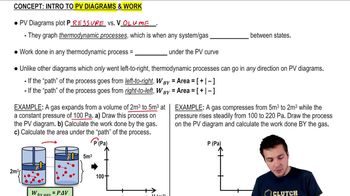
Work and PV Diagrams

Free-Body Diagrams

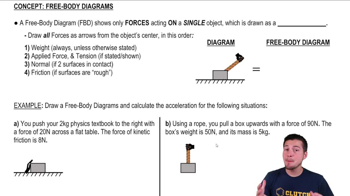
A free-body diagram is a graphical representation that shows all the forces acting on an object. For the Styrofoam ball, this diagram will include the gravitational force acting downward and the upward force of air resistance, allowing for a clear analysis of the net force and resulting acceleration during its flight.
Recommended video:
Guided course
08:42
Free-Body Diagrams

Air Resistance

Air resistance, or drag, is a force that opposes the motion of an object through air. It is particularly significant for lightweight objects like a Styrofoam ball, as it affects the ball's acceleration and velocity during its ascent and descent, making it crucial to consider when analyzing the ball's motion.
Recommended video:
Guided course
05:06
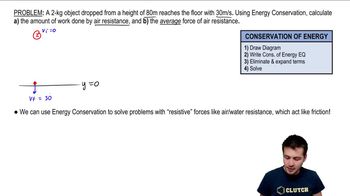
Energy Conservation with Air Resistance
Related Practice
Textbook Question

Problems 42, 43, 44, 45, 46, 47, 48, 49, 50, 51, and 52 describe a situation. For each, draw a motion diagram, a force-identification diagram, and a free-body diagram. A model rocket is fired straight down from the top of a tower.

11
views
Textbook Question

A rubber ball bounces. We'd like to understand how the ball bounces. A rubber ball has been dropped and is bouncing off the floor. Draw a motion diagram of the ball during the brief time interval that it is in contact with the floor. Show 4 or 5 frames as the ball compresses, then another 4 or 5 frames as it expands. What is the direction of a during each of these parts of the motion?

2
views
Textbook Question

A constant force is applied to an object, causing the object to accelerate at 10 m/s². What will the acceleration be if The force is halved and the object's mass is doubled?

3
views
Textbook Question

Problems 35, 36, 37, 38, 39, and 40 show a free-body diagram. For each: Identify the direction of the acceleration vector a and show it as a vector next to your diagram. Or, if appropriate, write a = 0.

2
views
Textbook Question

Problems 42, 43, 44, 45, 46, 47, 48, 49, 50, 51, and 52 describe a situation. For each, draw a motion diagram, a force-identification diagram, and a free-body diagram. A rocket is being launched straight up. Air resistance is not negligible.

3
views
Textbook Question

A constant force is applied to an object, causing the object to accelerate at 10 m/s². What will the acceleration be if the force is halved?

2
views