Ch 12: Rotation of a Rigid Body
Knight Calc - Physics for Scientists and Engineers 5th Edition
Knight Calc5th EditionPhysics for Scientists and EngineersISBN: 9780137344796Not the one you use?Change textbook
Chapter 12, Problem 16b

A 25 kg solid door is 220 cm tall, 91 cm wide. What is the door’s moment of inertia for rotation about a vertical axis inside the door, 15 cm from one edge?

Verified step by step guidance
1
Step 1: Understand the problem. The moment of inertia depends on the axis of rotation and the distribution of mass relative to that axis. Here, the door rotates about a vertical axis located 15 cm from one edge. The door can be treated as a rectangular solid with uniform mass distribution.
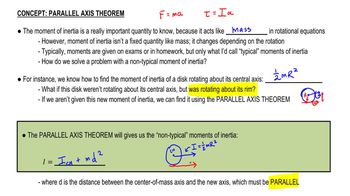
Step 2: Use the parallel axis theorem to calculate the moment of inertia. The theorem states: \( I = I_{cm} + Md^2 \), where \( I_{cm} \) is the moment of inertia about the center of mass, \( M \) is the mass of the door, and \( d \) is the distance from the center of mass to the new axis of rotation.
Step 3: Calculate \( I_{cm} \) for a rectangular solid rotating about an axis parallel to one of its edges. The formula is \( I_{cm} = \frac{1}{3} M h^2 \), where \( h \) is the width of the door (91 cm or 0.91 m). Substitute \( M = 25 \, \text{kg} \) and \( h = 0.91 \, \text{m} \) into the formula.
Step 4: Determine the distance \( d \) from the center of mass to the new axis of rotation. The center of mass is located at the midpoint of the door's width, which is \( \frac{91}{2} = 45.5 \, \text{cm} \). The new axis is 15 cm from one edge, so \( d = |45.5 - 15| = 30.5 \, \text{cm} \) or \( 0.305 \, \text{m} \).
Step 5: Combine the results using the parallel axis theorem. Substitute \( I_{cm} \) and \( d \) into \( I = I_{cm} + Md^2 \). Perform the necessary algebraic operations to express the moment of inertia in terms of the given values.

Verified video answer for a similar problem:

This video solution was recommended by our tutors as helpful for the problem above.
Video duration:
5m
Was this helpful?

Key Concepts

Here are the essential concepts you must grasp in order to answer the question correctly.

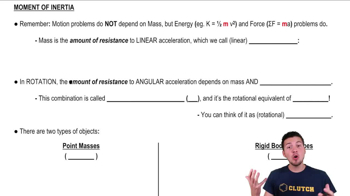
Moment of Inertia

Moment of inertia is a measure of an object's resistance to changes in its rotational motion about an axis. It depends on the mass distribution relative to the axis of rotation. For rigid bodies, it is calculated by integrating the mass elements multiplied by the square of their distance from the axis. The greater the distance of mass from the axis, the higher the moment of inertia.
Recommended video:
Guided course
11:47
Intro to Moment of Inertia

Parallel Axis Theorem

The parallel axis theorem allows us to calculate the moment of inertia of a body about any axis parallel to an axis through its center of mass. It states that the moment of inertia about the new axis is equal to the moment of inertia about the center of mass axis plus the product of the mass and the square of the distance between the two axes. This theorem is essential for determining the moment of inertia when the axis of rotation is not through the center of mass.
Recommended video:
Guided course
13:46
Parallel Axis Theorem

Geometry of the Door

Understanding the geometry of the door is crucial for calculating its moment of inertia. The door can be approximated as a rectangular solid, and its dimensions (height and width) will influence the distribution of mass. The specific axis of rotation, in this case, 15 cm from one edge, requires careful consideration of how the mass is distributed relative to that axis, impacting the final calculation of the moment of inertia.
Recommended video:
Guided course
07:06
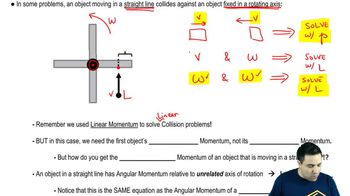
Angular Momentum of Objects in Linear Motion