Ch. 30 - Inductance, Electromagnetic Oscillations, and AC Circuits
Giancoli Douglas - Physics for Scientists and Engineers 5th edition
Giancoli Douglas5th editionPhysics for Scientists and EngineersISBN: 9780137488179Not the one you use?Change textbook
Chapter 29, Problem 65

The output of an electrocardiogram amplifier has an impedance of 45 Ω. It is to be connected to an 8.0-Ω loudspeaker through a transformer. What should be the turns ratio of the transformer?

Verified step by step guidance
1
Step 1: Understand the problem. The goal is to find the turns ratio of a transformer that connects an amplifier with an impedance of 45 Ω to a loudspeaker with an impedance of 8.0 Ω. The transformer is used to match the impedances for efficient power transfer.
Step 2: Recall the formula for impedance transformation in a transformer. The relationship between the primary impedance \( Z_p \) and the secondary impedance \( Z_s \) is given by: \( \frac{Z_p}{Z_s} = \left( \frac{N_p}{N_s} \right)^2 \), where \( N_p \) and \( N_s \) are the number of turns in the primary and secondary coils, respectively.
Step 3: Rearrange the formula to solve for the turns ratio \( \frac{N_p}{N_s} \): \( \frac{N_p}{N_s} = \sqrt{\frac{Z_p}{Z_s}} \).
Step 4: Substitute the given values into the formula. Here, \( Z_p = 45 \; \Omega \) and \( Z_s = 8.0 \; \Omega \). The turns ratio becomes \( \frac{N_p}{N_s} = \sqrt{\frac{45}{8.0}} \).
Step 5: Simplify the expression under the square root to find the numerical value of the turns ratio. This will give the ratio of the number of turns in the primary coil to the number of turns in the secondary coil.

Verified video answer for a similar problem:

This video solution was recommended by our tutors as helpful for the problem above.
Video duration:
2m
Was this helpful?

Key Concepts

Here are the essential concepts you must grasp in order to answer the question correctly.

Impedance Matching

Impedance matching is the process of making the output impedance of one device equal to the input impedance of another to maximize power transfer and minimize signal reflection. In this scenario, the electrocardiogram amplifier has an output impedance of 45 Ω, and it needs to be matched with the 8.0-Ω loudspeaker to ensure efficient energy transfer.
Recommended video:
Guided course
08:40
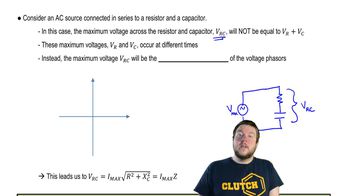
Impedance in AC Circuits

Transformer Turns Ratio

The turns ratio of a transformer is the ratio of the number of turns in the primary coil to the number of turns in the secondary coil. This ratio determines how voltage and current are transformed between the primary and secondary sides. In this case, the turns ratio will be crucial for converting the 45 Ω impedance of the amplifier to match the 8.0 Ω impedance of the loudspeaker.
Recommended video:

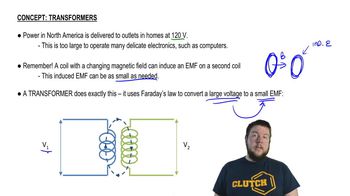
Impedance Transformation

Impedance transformation refers to the ability of a transformer to change the impedance seen by the source and load. The relationship between the primary and secondary impedances is given by the square of the turns ratio. To find the appropriate turns ratio for the transformer, one can use the formula: Zs = (Np/Ns)² * Zp, where Zs is the secondary impedance, Zp is the primary impedance, and Np and Ns are the number of turns in the primary and secondary coils, respectively.
Recommended video:
Related Practice
Textbook Question

The frequency of the ac voltage source (peak voltage Vo) in an LRC circuit is tuned to the circuit’s resonant frequency f₀ = 1 / (2π√LC). (a) Show that the peak voltage across the capacitor is Vco = VoTo/ (2πτ), where To ( =1/fo) is the period of the resonant frequency and τ = RC is the time constant for charging the capacitor C through a resistor R. (b) Define β = To/ (2πτ) so that Vco = βVo. Then β is the “amplification” of the source voltage across the capacitor. If a particular LRC circuit contains a 2.0-nF capacitor and has a resonant frequency of 5.0 kHz, what value of R will yield β = 125?

2
views
Textbook Question

(II) (a) Show that oscillation of charge Q on the capacitor of an LRC circuit has amplitude


Q0=V0(ωR)2+(ω2L1C)2.Q_0 = \(\frac{V_0}{\sqrt{(\omega R)^2 + \left(\omega^2 L - \frac{1}{C}\]\right\))^2}}.

1
views
Textbook Question

At t = 0, the current through a 60.0-mH inductor is 50.0 mA and is increasing at the rate of 78.0 mA/s. What is the initial energy stored in the inductor, and how long does it take for the energy to increase by a factor of 8.0 from the initial value?

2
views
Textbook Question

At time t = 0, the switch in the circuit shown in Fig. 30–30 is closed. After a sufficiently long time, steady currents I₁, I₂, and I₃ flow through resistors R₁, R₂, and R₃, respectively. Determine these three currents.

2
views
Textbook Question

An average power output of 150 W is sent into a 4-Ω loudspeaker (see Fig. 25–14). What are the rms voltage and the rms current fed to the speaker at 1.0 W when the volume is turned down?

1
views
Textbook Question

Show that the power delivered by a three-phase ac source equals a constant P = 3Vo²/2R, by combining the four equations in Section 30–11.

2
views