
Ch. 30 - Inductance, Electromagnetic Oscillations, and AC Circuits
Giancoli Douglas - Physics for Scientists and Engineers 5th edition
Giancoli Douglas5th editionPhysics for Scientists and EngineersISBN: 9780137488179Not the one you use?Change textbook
Chapter 29, Problem 68

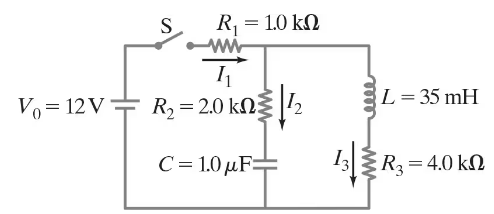
At time t = 0, the switch in the circuit shown in Fig. 30–30 is closed. After a sufficiently long time, steady currents I₁, I₂, and I₃ flow through resistors R₁, R₂, and R₃, respectively. Determine these three currents.

Verified step by step guidance
1
Identify the circuit configuration after a long time has passed. In steady-state conditions for an RC circuit, the capacitor acts as an open circuit because the current through the capacitor becomes zero. This simplifies the circuit to a purely resistive network.
Apply Kirchhoff's Voltage Law (KVL) to the loops in the circuit. Write equations for the voltage drops across the resistors R₁, R₂, and R₃, considering the battery voltage and the direction of the currents I₁, I₂, and I₃.
Use Ohm's Law, which states that the voltage drop across a resistor is given by \( V = IR \), to express the voltage drops in terms of the currents and resistances. For example, the voltage drop across R₁ is \( I₁ R₁ \).
Apply Kirchhoff's Current Law (KCL) at the junctions in the circuit. This law states that the total current entering a junction equals the total current leaving the junction. Use this to relate I₁, I₂, and I₃.
Solve the system of equations obtained from KVL and KCL to determine the values of I₁, I₂, and I₃. This will involve substituting the resistances and battery voltage into the equations and solving for the currents.

Verified video answer for a similar problem:

This video solution was recommended by our tutors as helpful for the problem above.
Video duration:
1m
Was this helpful?

Key Concepts

Here are the essential concepts you must grasp in order to answer the question correctly.

Ohm's Law

Ohm's Law states that the current (I) flowing through a conductor between two points is directly proportional to the voltage (V) across the two points and inversely proportional to the resistance (R) of the conductor. This relationship is expressed mathematically as V = IR. Understanding this law is essential for analyzing circuits, as it allows us to calculate the current through each resistor when the voltage and resistance values are known.
Recommended video:
Guided course
03:07
Resistance and Ohm's Law

Kirchhoff's Laws

Kirchhoff's Laws consist of two fundamental principles for circuit analysis: Kirchhoff's Current Law (KCL) and Kirchhoff's Voltage Law (KVL). KCL states that the total current entering a junction must equal the total current leaving it, while KVL states that the sum of the electrical potential differences (voltage) around any closed circuit loop must equal zero. These laws are crucial for determining the currents in complex circuits with multiple branches.
Recommended video:
Guided course
04:08
Kirchhoff's Junction Rule

Steady State in Circuits

The steady state in electrical circuits refers to the condition where all circuit variables (currents and voltages) remain constant over time after transient effects have dissipated. In this state, the circuit has reached equilibrium, and the currents through the resistors can be calculated using Ohm's Law and Kirchhoff's Laws. Understanding the steady state is important for analyzing circuits that have been powered for a sufficient duration, as it simplifies the calculations involved.
Recommended video:
Related Practice
Textbook Question

At t = 0, the current through a 60.0-mH inductor is 50.0 mA and is increasing at the rate of 78.0 mA/s. What is the initial energy stored in the inductor, and how long does it take for the energy to increase by a factor of 8.0 from the initial value?

2
views
Textbook Question

An ac voltage source V = Vo sin (ωt + 90°) is connected across an inductor L and current I = Io sin (ωt) flows in this circuit. Note that the current and source voltage are 90° out of phase.

(a) Directly calculate the average power delivered by the source over one period T of its sinusoidal cycle via the integral P = ∫₀ᵀ VI dt/T.

(b) Apply the relation P = Iᵣₘₛ Vᵣₘₛ cos Φ to this circuit and show that the answer you obtain is consistent with that found in part (a). Comment on your results.

7
views
Textbook Question

The output of an electrocardiogram amplifier has an impedance of 45 Ω. It is to be connected to an 8.0-Ω loudspeaker through a transformer. What should be the turns ratio of the transformer?

Textbook Question

A pair of straight parallel thin wires, such as a lamp cord, each of radius r, are a distance 𝓁 apart and carry current to a circuit some distance away. Ignoring the field within each wire, show that the inductance per unit length is (μ₀/π) ln[(𝓁 - r) /r].

1
views
Textbook Question

Show that the power delivered by a three-phase ac source equals a constant P = 3Vo²/2R, by combining the four equations in Section 30–11.

2
views
Textbook Question

For an underdamped LRC circuit, determine a formula for the energy U = UE + UB stored in the electric and magnetic fields as a function of time. Give answer in terms of the initial charge Qo on the capacitor.

1
views