
Ch. 30 - Inductance, Electromagnetic Oscillations, and AC Circuits
Giancoli Douglas - Physics for Scientists and Engineers 5th edition
Giancoli Douglas5th editionPhysics for Scientists and EngineersISBN: 9780137488179Not the one you use?Change textbook
Chapter 29, Problem 70

A pair of straight parallel thin wires, such as a lamp cord, each of radius r, are a distance 𝓁 apart and carry current to a circuit some distance away. Ignoring the field within each wire, show that the inductance per unit length is (μ₀/π) ln[(𝓁 - r) /r].

Verified step by step guidance
1
Start by recalling the formula for the inductance per unit length of a pair of parallel wires. The inductance arises from the magnetic field generated by the current in one wire and the flux linkage with the other wire. The magnetic field outside a long straight wire carrying current I is given by Ampere's law: B = (μ₀I) / (2πr), where r is the radial distance from the wire.
Consider the magnetic flux linkage between the two wires. The magnetic field from one wire at a distance x from its center contributes to the flux linkage with the other wire. The flux per unit length is calculated by integrating the magnetic field over the region between the wires, from r (the surface of the wire) to (𝓁 - r) (the closest point to the other wire).
The flux linkage per unit length, λ, is given by: λ = ∫[r to (𝓁 - r)] (B dx), where B = (μ₀I) / (2πx). Substitute B into the integral: λ = ∫[r to (𝓁 - r)] [(μ₀I) / (2πx)] dx.
Solve the integral: λ = (μ₀I) / (2π) ∫[r to (𝓁 - r)] (1/x) dx. The integral of 1/x is ln(x), so λ = (μ₀I) / (2π) [ln(𝓁 - r) - ln(r)]. Using the logarithmic property ln(a) - ln(b) = ln(a/b), this simplifies to λ = (μ₀I) / (2π) ln[(𝓁 - r) / r].
Finally, the inductance per unit length, L, is defined as the flux linkage per unit current: L = λ / I. Substituting λ, we get L = [(μ₀I) / (2π) ln((𝓁 - r) / r)] / I. Simplify by canceling I, resulting in L = (μ₀ / π) ln[(𝓁 - r) / r].

Verified video answer for a similar problem:

This video solution was recommended by our tutors as helpful for the problem above.
Video duration:
7m
Was this helpful?

Key Concepts

Here are the essential concepts you must grasp in order to answer the question correctly.

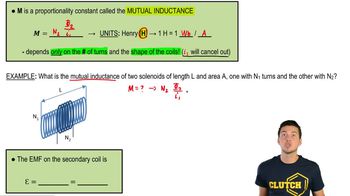
Inductance

Inductance is a property of an electrical circuit that quantifies the ability of a conductor to induce an electromotive force (EMF) in itself or in another conductor due to a change in current. It is measured in henries (H) and is crucial for understanding how circuits respond to alternating current (AC) and the behavior of inductors in various applications.
Recommended video:
Guided course
12:59
Mutual Induction

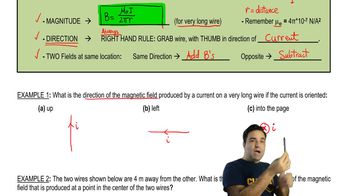
Magnetic Field Due to Current

When an electric current flows through a conductor, it generates a magnetic field around it. For parallel wires, the magnetic field produced by one wire affects the other, leading to interactions that are essential for calculating inductance. The strength and direction of this magnetic field depend on the current and the distance from the wire.
Recommended video:
Guided course
12:33
Magnetic Field Produced by Straight Currents

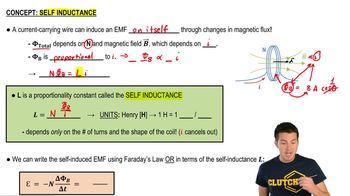
Logarithmic Relationship in Inductance

The formula for inductance per unit length in parallel wires involves a logarithmic relationship, which arises from the geometry of the wires and their separation. Specifically, the inductance is proportional to the natural logarithm of the ratio of the distance between the wires minus the radius of the wires to the radius itself, reflecting how the magnetic field lines interact in space.
Recommended video:
Guided course
07:58
Self Inductance
Related Practice
Textbook Question

At t = 0, the current through a 60.0-mH inductor is 50.0 mA and is increasing at the rate of 78.0 mA/s. What is the initial energy stored in the inductor, and how long does it take for the energy to increase by a factor of 8.0 from the initial value?

2
views
Textbook Question

An ac voltage source V = Vo sin (ωt + 90°) is connected across an inductor L and current I = Io sin (ωt) flows in this circuit. Note that the current and source voltage are 90° out of phase.

(a) Directly calculate the average power delivered by the source over one period T of its sinusoidal cycle via the integral P = ∫₀ᵀ VI dt/T.

(b) Apply the relation P = Iᵣₘₛ Vᵣₘₛ cos Φ to this circuit and show that the answer you obtain is consistent with that found in part (a). Comment on your results.

7
views
Textbook Question

An inductance coil draws 2.2 A dc when connected to a 45-V battery. When connected to a 60.0-Hz 120-V (rms) source, the current drawn is 3.8 A (rms). Determine the inductance and resistance of the coil.

1
views
Textbook Question

At time t = 0, the switch in the circuit shown in Fig. 30–30 is closed. After a sufficiently long time, steady currents I₁, I₂, and I₃ flow through resistors R₁, R₂, and R₃, respectively. Determine these three currents.

2
views
Textbook Question

Show that the power delivered by a three-phase ac source equals a constant P = 3Vo²/2R, by combining the four equations in Section 30–11.

2
views
Textbook Question

For an underdamped LRC circuit, determine a formula for the energy U = UE + UB stored in the electric and magnetic fields as a function of time. Give answer in terms of the initial charge Qo on the capacitor.

1
views