Ch 12: Rotation of a Rigid Body
Knight Calc - Physics for Scientists and Engineers 5th Edition
Knight Calc5th EditionPhysics for Scientists and EngineersISBN: 9780137344796Not the one you use?Change textbook
Chapter 12, Problem 48b

A toy gyroscope has a ring of mass M and radius R attached to the axle by lightweight spokes. The end of the axle is distance R from the center of the ring. The gyroscope is spun at angular velocity ω, then the end of the axle is placed on a support that allows the gyroscope to precess. A 120 g, 8.0-cm-diameter gyroscope is spun at 1000 rpm and allowed to precess. What is the precession period?

Verified step by step guidance
1
Convert the given values into SI units. The mass of the gyroscope is given as 120 g, which should be converted to kilograms: \( M = 0.120 \; \text{kg} \). The diameter is 8.0 cm, so the radius is \( R = 0.08 / 2 = 0.04 \; \text{m} \). The angular velocity is given as 1000 rpm, which should be converted to radians per second: \( \omega = \frac{1000 \times 2\pi}{60} \; \text{rad/s} \).
Calculate the moment of inertia of the gyroscope. Since the gyroscope is modeled as a ring, its moment of inertia about its axis of rotation is given by \( I = M R^2 \). Substitute the values of \( M \) and \( R \) to find \( I \).
Determine the torque due to gravity. The torque is given by \( \tau = M g R \), where \( g \) is the acceleration due to gravity (\( 9.8 \; \text{m/s}^2 \)). Substitute the values of \( M \), \( g \), and \( R \) to calculate \( \tau \).
Relate the precession angular velocity \( \Omega \) to the torque and angular momentum. The precession angular velocity is given by \( \Omega = \frac{\tau}{L} \), where \( L \) is the angular momentum of the gyroscope. The angular momentum is \( L = I \omega \). Substitute \( \tau \), \( I \), and \( \omega \) to find \( \Omega \).
Calculate the precession period. The precession period \( T \) is the time it takes for one complete precession, which is related to the precession angular velocity by \( T = \frac{2\pi}{\Omega} \). Substitute the value of \( \Omega \) to find \( T \).

Verified video answer for a similar problem:

This video solution was recommended by our tutors as helpful for the problem above.
Was this helpful?

Key Concepts

Here are the essential concepts you must grasp in order to answer the question correctly.

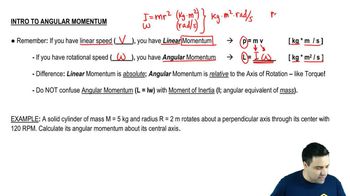
Angular Momentum

Angular momentum is a measure of the rotational motion of an object and is defined as the product of the moment of inertia and the angular velocity. For a gyroscope, it plays a crucial role in understanding how the system behaves when subjected to external torques. The conservation of angular momentum is key to analyzing the precession of the gyroscope, as it remains constant unless acted upon by an external force.
Recommended video:
Guided course
06:18
Intro to Angular Momentum

Precession

Precession is the phenomenon where the axis of a spinning object, like a gyroscope, moves in a circular path due to an external torque. This occurs when the gravitational force acts on the center of mass of the gyroscope, causing it to tilt and rotate around a vertical axis. The rate of precession is influenced by the angular momentum of the gyroscope and the torque applied, which is essential for calculating the precession period.

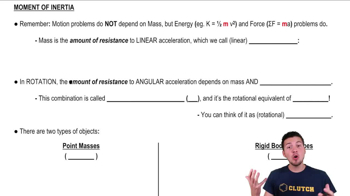
Moment of Inertia

The moment of inertia is a scalar value that quantifies how mass is distributed relative to an axis of rotation. It determines how much torque is needed for a desired angular acceleration. In the context of the gyroscope, the moment of inertia affects both the angular momentum and the precession behavior, as a larger moment of inertia results in slower changes to the gyroscope's orientation when subjected to external forces.
Recommended video:
Guided course
11:47
Intro to Moment of Inertia