Ch 12: Rotation of a Rigid Body
Knight Calc - Physics for Scientists and Engineers 5th Edition
Knight Calc5th EditionPhysics for Scientists and EngineersISBN: 9780137344796Not the one you use?Change textbook
Chapter 12, Problem 44

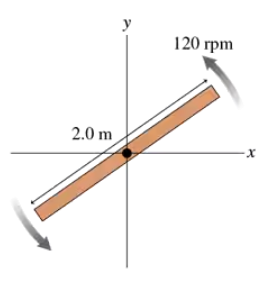
What is the angular momentum vector of the 500 g rotating bar in FIGURE EX12.44? Give your answer using unit vectors.

Verified step by step guidance
1
Identify the given quantities: The mass of the bar is 500 g (convert to kilograms: 0.5 kg), and the figure (FIGURE EX12.44) likely provides the bar's length, angular velocity, and axis of rotation. Ensure you extract these values from the figure.
Recall the formula for angular momentum of a rigid body rotating about a fixed axis: **L = Iω**, where **L** is the angular momentum vector, **I** is the moment of inertia, and **ω** is the angular velocity vector.
Determine the moment of inertia **I** for the bar. For a uniform bar rotating about its center, the moment of inertia is given by **I = (1/12)ML²**, where **M** is the mass of the bar and **L** is its length. Substitute the known values for **M** and **L**.
Express the angular velocity vector **ω** in terms of its magnitude and direction. The direction of **ω** is determined by the right-hand rule, and its magnitude is given in the figure. Write **ω** in unit vector form.
Combine the results: Multiply the scalar moment of inertia **I** by the angular velocity vector **ω** to find the angular momentum vector **L**. Express the final result in unit vector form, ensuring the correct direction and magnitude.

Verified video answer for a similar problem:

This video solution was recommended by our tutors as helpful for the problem above.
Video duration:
4m
Was this helpful?

Key Concepts

Here are the essential concepts you must grasp in order to answer the question correctly.

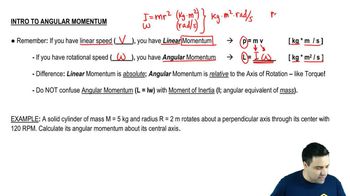
Angular Momentum

Angular momentum is a vector quantity that represents the rotational inertia and rotational velocity of an object. It is calculated as the product of the moment of inertia and the angular velocity. For a rotating object, angular momentum can be expressed in terms of its mass distribution and the axis of rotation, making it crucial for understanding rotational dynamics.
Recommended video:
Guided course
06:18
Intro to Angular Momentum

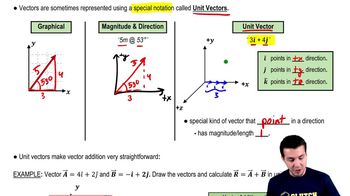
Unit Vectors

Unit vectors are vectors that have a magnitude of one and are used to indicate direction. In three-dimensional space, unit vectors are typically represented as i, j, and k, corresponding to the x, y, and z axes, respectively. When expressing angular momentum in terms of unit vectors, it allows for a clear representation of its direction and magnitude in a coordinate system.
Recommended video:

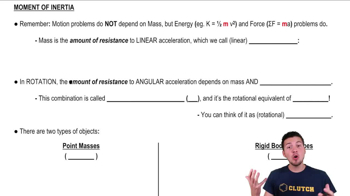
Moment of Inertia

The moment of inertia is a scalar value that quantifies how mass is distributed relative to an axis of rotation. It plays a critical role in determining an object's resistance to changes in its rotational motion. For a bar, the moment of inertia depends on its mass and the distance of its mass from the axis of rotation, influencing the calculation of angular momentum.
Recommended video:
Guided course
11:47
Intro to Moment of Inertia