Ch 12: Rotation of a Rigid Body
Knight Calc - Physics for Scientists and Engineers 5th Edition
Knight Calc5th EditionPhysics for Scientists and EngineersISBN: 9780137344796Not the one you use?Change textbook
Chapter 12, Problem 40

Force F=10j^N\(\vec{F}\) = -10\(\hat{j}\) \, \(\text{N}\) is exerted on a particle at r=(5i^+5j^)m\(\vec{r}\) = (5\(\hat{i}\) + 5\(\hat{j}\)) \, \(\text{m}\). What is the torque on the particle about the origin?

Verified step by step guidance
1
Step 1: Recall the formula for torque, which is the cross product of the position vector (𝓇) and the force vector (𝐹). Mathematically, torque (𝜏) is given by: τ = r × F.
Step 2: Write down the given vectors. The position vector is r = 5î + 5ĵ (in meters), and the force vector is F = -10ĵ (in newtons).
Step 3: Set up the cross product. The cross product of two vectors in 3D space can be calculated using the determinant of a matrix. Write the determinant as: |îĵ5500-100|.
Step 4: Expand the determinant to compute the cross product. Use cofactor expansion along the first row: τ = î(5(0) - 0(-10)) - ĵ(5(0) - 0(0)) + (5(-10) - 5(0)).
Step 5: Simplify the terms. After performing the calculations, the torque vector will only have a component in the direction. The final expression for the torque is: τ = -50 (in N·m).

Verified video answer for a similar problem:

This video solution was recommended by our tutors as helpful for the problem above.
Video duration:
4m
Was this helpful?

Key Concepts

Here are the essential concepts you must grasp in order to answer the question correctly.

Torque

Torque is a measure of the rotational force applied to an object, calculated as the cross product of the position vector and the force vector. It determines how effectively a force can cause an object to rotate about a pivot point, in this case, the origin. The direction of torque is given by the right-hand rule, indicating the axis of rotation.
Recommended video:
Guided course
08:55
Net Torque & Sign of Torque

Cross Product

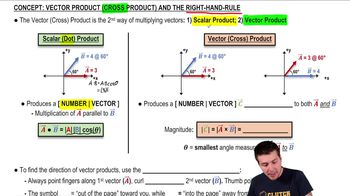
The cross product is a mathematical operation that takes two vectors and produces a third vector that is perpendicular to the plane formed by the original vectors. In the context of torque, the cross product of the position vector and the force vector yields the torque vector, which has both magnitude and direction, essential for understanding rotational dynamics.
Recommended video:
Guided course
10:30
Vector (Cross) Product and the Right-Hand-Rule

Position Vector

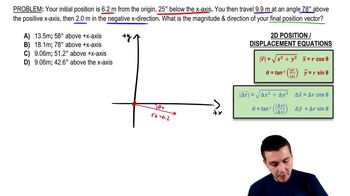
The position vector represents the location of a point in space relative to a reference point, typically the origin in physics problems. It is expressed in terms of its components along the coordinate axes. In this question, the position vector (5î + 5ĵ) m indicates the particle's position in a two-dimensional plane, which is crucial for calculating torque.
Recommended video:
Guided course
07:07
Final Position Vector