Ch 13: Newton's Theory of Gravity
Knight Calc - Physics for Scientists and Engineers 5th Edition
Knight Calc5th EditionPhysics for Scientists and EngineersISBN: 9780137344796Not the one you use?Change textbook
Chapter 13, Problem 45

Suppose that on earth you can jump straight up a distance of 45 cm. Asteroids are made of material with mass density 2800 kg/m³ . What is the maximum diameter of a spherical asteroid from which you could escape by jumping?

Verified step by step guidance
1
Step 1: Begin by understanding the concept of escape velocity. Escape velocity is the minimum speed needed for an object to escape the gravitational pull of a celestial body without further propulsion. For a spherical asteroid, the escape velocity is determined by its mass and radius.
Step 2: Write the formula for escape velocity: vescape = √(2GM/R), where G is the gravitational constant (6.674 × 10⁻¹¹ N·m²/kg²), M is the mass of the asteroid, and R is its radius.
Step 3: Relate the mass of the asteroid to its density and volume. The mass M can be expressed as M = ρV, where ρ is the density of the asteroid (2800 kg/m³) and V is its volume. For a sphere, the volume is given by V = (4/3)πR³.
Step 4: Substitute M = ρ(4/3)πR³ into the escape velocity formula. This gives vescape = √(2Gρ(4/3)πR²). Simplify the expression to find the relationship between escape velocity and radius.
Step 5: Set the escape velocity equal to the maximum jump velocity on Earth. Use the kinematic equation v = √(2gh), where g is the acceleration due to gravity on Earth (9.8 m/s²) and h is the jump height (0.45 m). Solve for R to find the maximum diameter of the asteroid.

Verified video answer for a similar problem:

This video solution was recommended by our tutors as helpful for the problem above.
Was this helpful?

Key Concepts

Here are the essential concepts you must grasp in order to answer the question correctly.

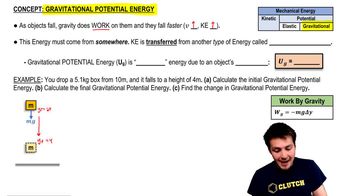
Gravitational Potential Energy

Gravitational potential energy (GPE) is the energy an object possesses due to its position in a gravitational field. It is calculated using the formula GPE = mgh, where m is mass, g is the acceleration due to gravity, and h is the height. In the context of jumping, the maximum height reached is directly related to the GPE converted from the kinetic energy of the jump.
Recommended video:
Guided course
06:35
Gravitational Potential Energy

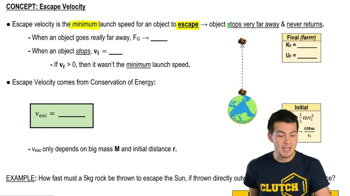
Escape Velocity

Escape velocity is the minimum speed needed for an object to break free from the gravitational attraction of a celestial body without further propulsion. It depends on the mass and radius of the body, given by the formula v = √(2GM/R), where G is the gravitational constant, M is the mass of the body, and R is its radius. Understanding escape velocity is crucial for determining how high one must jump to escape an asteroid's gravity.
Recommended video:
Guided course
7:27
Escape Velocity

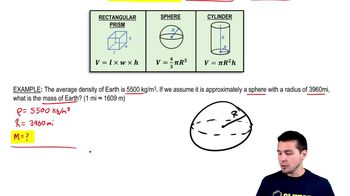
Mass Density

Mass density is defined as mass per unit volume, typically expressed in kg/m³. It is a critical factor in determining the mass of an object when its volume is known. For the asteroid in question, knowing its mass density allows us to calculate its mass based on its volume, which is essential for applying the escape velocity formula and understanding the gravitational effects on jumping.
Recommended video:
Guided course
04:33
Problems with Mass, Volume, & Density