
Ch 13: Newton's Theory of Gravity
Knight Calc - Physics for Scientists and Engineers 5th Edition
Knight Calc5th EditionPhysics for Scientists and EngineersISBN: 9780137344796Not the one you use?Change textbook
Chapter 13, Problem 48b

The two stars in a binary star system have masses 2.0 x 10³⁰ kg and 6.0 x 10³⁰ kg. They are separated by 2.0 x 10¹² m. What are The speed of each star?

Verified step by step guidance
1
Step 1: Understand the problem. In a binary star system, the two stars orbit their common center of mass due to gravitational attraction. To find the speed of each star, we need to use the concept of circular motion and the gravitational force acting between the two stars.
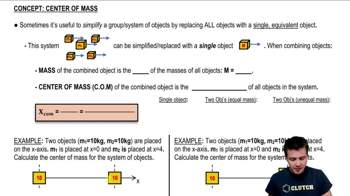
Step 2: Calculate the center of mass of the system. The center of mass is given by the formula: x=m1x1+m2x2m1+m2. Here, m1 and m2 are the masses of the stars, and x1 and x2 are their positions. Use this formula to find the distance of each star from the center of mass.
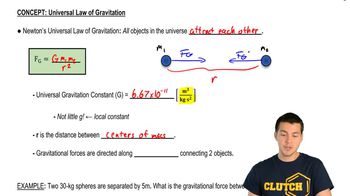
Step 3: Apply Newton's law of gravitation to find the gravitational force between the two stars. The formula is: F=Gm1m2r2, where G is the gravitational constant, r is the separation between the stars, and F is the gravitational force.
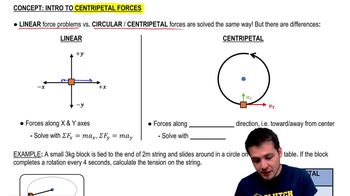
Step 4: Use the concept of circular motion to relate the gravitational force to the centripetal force for each star. The centripetal force is given by: F=mv2r, where v is the speed of the star and r is its distance from the center of mass. Equate the gravitational force to the centripetal force for each star to solve for their speeds.
Step 5: Solve the equations for the speed of each star. For the first star, substitute its mass and distance from the center of mass into the equation. Repeat the process for the second star. Ensure that the speeds are consistent with the orbital motion around the center of mass.

Verified video answer for a similar problem:

This video solution was recommended by our tutors as helpful for the problem above.
Was this helpful?

Key Concepts

Here are the essential concepts you must grasp in order to answer the question correctly.

Newton's Law of Universal Gravitation

Newton's Law of Universal Gravitation states that every mass attracts every other mass in the universe with a force that is directly proportional to the product of their masses and inversely proportional to the square of the distance between their centers. This law is fundamental in understanding the gravitational forces acting between the two stars in a binary system.
Recommended video:
Guided course
04:05
Universal Law of Gravitation

Circular Motion and Centripetal Force

In a binary star system, each star orbits around a common center of mass, and their motion can be described as circular motion. The centripetal force required to keep each star in orbit is provided by the gravitational attraction between them. Understanding the relationship between gravitational force and centripetal force is essential for calculating the speeds of the stars.
Recommended video:
Guided course
06:48
Intro to Centripetal Forces

Center of Mass

The center of mass of a binary star system is the point where the two stars balance each other due to their masses. The distance of each star from the center of mass is inversely proportional to its mass, which affects their orbital speeds. Knowing the position of the center of mass is crucial for determining how fast each star moves in relation to this point.
Recommended video:
Guided course
06:30
Intro to Center of Mass
Related Practice
Textbook Question

A 4000 kg lunar lander is in orbit 50 km above the surface of the moon. It needs to move out to a 300-km-high orbit in order to link up with the mother ship that will take the astronauts home. How much work must the thrusters do?

1
views
Textbook Question

Suppose that on earth you can jump straight up a distance of 45 cm. Asteroids are made of material with mass density 2800 kg/m³ . What is the maximum diameter of a spherical asteroid from which you could escape by jumping?

1
views
Textbook Question

Two spherical objects have a combined mass of 400 kg. The gravitational attraction between them is 6.00 x 10⁻⁷ N and their gravitational potential energy is ₋1.20 x 10⁻⁶ J. What is the mass of each?

1
views
Textbook Question

A starship is circling a distant planet of radius R. The astronauts find that the free-fall acceleration at their altitude is half the value at the planet's surface. How far above the surface are they orbiting? Your answer will be a multiple of R.

2
views
Textbook Question

A rogue band of colonists on the moon declares war and prepares to use a catapult to launch large boulders at the earth. Assume that the boulders are launched from the point on the moon nearest the earth. For this problem you can ignore the rotation of the two bodies and the orbiting of the moon. What is the minimum speed with which a boulder must be launched to reach the earth? Hint: The minimum speed is not the escape speed. You need to analyze a three-body system.

1
views
Textbook Question

The 75,000 kg space shuttle used to fly in a 250-km-high circular orbit. It needed to reach a 610-km-high circular orbit to service the Hubble Space Telescope. How much energy was required to boost it to the new orbit?

1
views