Ch 13: Newton's Theory of Gravity
Knight Calc - Physics for Scientists and Engineers 5th Edition
Knight Calc5th EditionPhysics for Scientists and EngineersISBN: 9780137344796Not the one you use?Change textbook
Chapter 13, Problem 39

Two spherical objects have a combined mass of 150 kg. The gravitational attraction between them is 8.00 x 10⁻⁶ N when their centers are 20 cm apart. What is the mass of each?

Verified step by step guidance
1
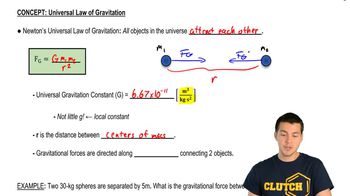
Start by recalling Newton's law of universal gravitation: F = \(\frac{G m_1 m_2}{r^2}\), where F is the gravitational force, G is the gravitational constant (6.674 \(\times\) 10^{-11} \ \(\text{N·m}\)^2/\(\text{kg}\)^2), m_1 and m_2 are the masses of the two objects, and r is the distance between their centers.
Substitute the known values into the formula: 8.00 \(\times\) 10^{-6} = \(\frac{(6.674 \times 10^{-11}\)) m_1 m_2}{(0.20)^2}. Note that the distance r is converted to meters (20 cm = 0.20 m).
Simplify the equation to isolate the product of the masses: m_1 m_2 = \(\frac{(8.00 \times 10^{-6}\)) (0.20)^2}{6.674 \(\times\) 10^{-11}}. This gives the value of m_1 m_2.
Use the fact that the combined mass of the two objects is 150 kg: m_1 + m_2 = 150. This provides a second equation to solve for m_1 and m_2.
Solve the system of equations: m_1 m_2 = \(\text{value from step 3}\) and m_1 + m_2 = 150. Use substitution or the quadratic formula to find the individual masses m_1 and m_2.

Verified video answer for a similar problem:

This video solution was recommended by our tutors as helpful for the problem above.
Video duration:
8m
Was this helpful?

Key Concepts

Here are the essential concepts you must grasp in order to answer the question correctly.

Newton's Law of Universal Gravitation

This law states that every point mass attracts every other point mass in the universe with a force that is directly proportional to the product of their masses and inversely proportional to the square of the distance between their centers. The formula is F = G(m1*m2)/r², where F is the gravitational force, G is the gravitational constant, m1 and m2 are the masses, and r is the distance between the centers.
Recommended video:
Guided course
04:05
Universal Law of Gravitation

Mass and Weight

Mass is a measure of the amount of matter in an object, typically measured in kilograms. Weight, on the other hand, is the force exerted by gravity on that mass. In this problem, the combined mass of the two objects is given, which is essential for determining the individual masses using the gravitational force between them.
Recommended video:
Guided course
10:19
Torque Due to Weight

Algebraic Manipulation

Algebraic manipulation involves rearranging equations to isolate variables and solve for unknowns. In this context, it is necessary to express the masses of the two objects in terms of their combined mass and the gravitational force, allowing for the calculation of each mass using the provided information.
Recommended video:
Guided course
4:06
Simplifying Algebraic Expression