A horizontal rope is tied to a 50 kg box on frictionless ice. What is the tension in the rope if: The box moves at a steady 5.0 m/s?
Ch 06: Dynamics I: Motion Along a Line
Knight Calc5th EditionPhysics for Scientists and EngineersISBN: 9780137344796Not the one you use?Change textbook
Chapter 6, Problem 16b
The position of a 2.0 kg mass is given by x = (2t3 - 3t2) where t is in seconds. What is the net horizontal force on the mass at t = 1s?
Verified step by step guidance1
Step 1: Understand the problem. The position of the mass is given as a function of time, x(t) = 2t³ - 3t². To find the net horizontal force, we need to calculate the acceleration at t = 1s using Newton's second law, F = ma, where m is the mass and a is the acceleration.
Step 2: Differentiate the position function x(t) = 2t³ - 3t² with respect to time to find the velocity v(t). The velocity is the first derivative of position: v(t) = dx/dt = d/dt(2t³ - 3t²).
Step 3: Differentiate the velocity function v(t) with respect to time to find the acceleration a(t). The acceleration is the second derivative of position: a(t) = dv/dt = d²x/dt². Perform the differentiation to obtain a(t).
Step 4: Substitute t = 1s into the acceleration function a(t) to calculate the acceleration at that specific time.
Step 5: Use Newton's second law, F = ma, to calculate the net horizontal force. Substitute the mass m = 2.0 kg and the acceleration a(t) at t = 1s into the equation to find the force.

Verified video answer for a similar problem:
This video solution was recommended by our tutors as helpful for the problem above.
Video duration:
5mWas this helpful?
Key Concepts
Here are the essential concepts you must grasp in order to answer the question correctly.
Newton's Second Law of Motion
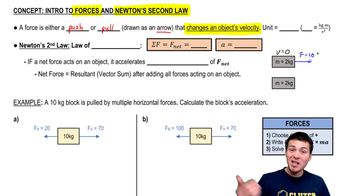
Newton's Second Law states that the net force acting on an object is equal to the mass of the object multiplied by its acceleration (F = ma). This principle is fundamental for analyzing motion, as it allows us to relate the forces acting on an object to its resulting acceleration and, consequently, its position over time.
Recommended video:
Guided course
Intro to Forces & Newton's Second Law
Acceleration
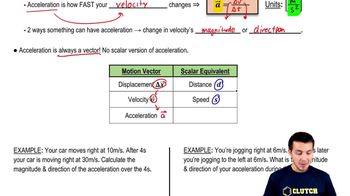
Acceleration is defined as the rate of change of velocity of an object with respect to time. It can be calculated as the second derivative of position with respect to time. In this problem, we need to find the acceleration of the mass by differentiating the position function twice, which will help us determine the net force acting on the mass.
Recommended video:
Guided course
Intro to Acceleration
Kinematics
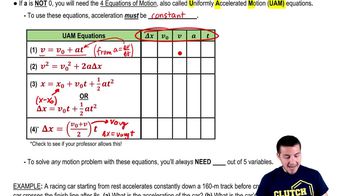
Kinematics is the branch of mechanics that deals with the motion of objects without considering the forces that cause the motion. It involves equations that describe the relationships between position, velocity, and acceleration. In this question, the position function provided allows us to analyze the motion of the mass and derive the necessary quantities to find the net force.
Recommended video:
Guided course
Kinematics Equations
Related Practice
Textbook Question
3
views
1
rank
Textbook Question
A woman has a mass of 55 kg. What is her weight while standing on earth?
2
views
Textbook Question
It takes the elevator in a skyscraper 4.0 s to reach its cruising speed of 10 m/s. A 60 kg passenger gets aboard on the ground floor. What is the passenger's weight before the elevator starts moving?
4
views
Textbook Question
A 50 kg box hangs from a rope. What is the tension in the rope if: The box moves up at a steady 5.0 m/s?
2
views
Textbook Question
A 50 kg box hangs from a rope. What is the tension in the rope if: The box has vy = 5.0 m/s and is speeding up at 5.0 m/s2
3
views
Textbook Question
It takes the elevator in a skyscraper 4.0 s to reach its cruising speed of 10 m/s. A 60 kg passenger gets aboard on the ground floor. What is the passenger's weight after the elevator reaches its cruising speed?
2
views