
Ch 04: Kinematics in Two Dimensions
Knight Calc - Physics for Scientists and Engineers 5th Edition
Knight Calc5th EditionPhysics for Scientists and EngineersISBN: 9780137344796Not the one you use?Change textbook
Chapter 4, Problem 72

A 25 g steel ball is attached to the top of a 24-cm-diameter vertical wheel. Starting from rest, the wheel accelerates at 470 rad/s². The ball is released after ¾ of a revolution. How high does it go above the center of the wheel?

Verified step by step guidance
1
Step 1: Convert the diameter of the wheel to radius. The diameter is given as 24 cm, so the radius is half of the diameter: \( r = \frac{24}{2} \) cm = 12 cm = 0.12 m.
Step 2: Determine the angular displacement of the ball before release. Since the ball is released after \( \frac{3}{4} \) of a revolution, the angular displacement is \( \theta = \frac{3}{4} \times 2\pi \) radians.
Step 3: Calculate the tangential velocity of the ball at the point of release. Use the formula \( v = \omega r \), where \( \omega \) is the angular velocity. First, find \( \omega \) using \( \omega^2 = \omega_0^2 + 2\alpha\theta \), where \( \omega_0 = 0 \) (starting from rest), \( \alpha = 470 \) rad/s², and \( \theta \) is the angular displacement calculated in Step 2.
Step 4: Determine the vertical velocity component of the ball at the point of release. The tangential velocity is perpendicular to the radius, so the vertical component is \( v_y = v \sin(\theta_{release}) \), where \( \theta_{release} \) is the angle corresponding to \( \frac{3}{4} \) of a revolution (i.e., \( \theta_{release} = \frac{3}{4} \times 360° = 270° \), or \( \frac{3\pi}{2} \) radians).
Step 5: Calculate the maximum height the ball reaches above the center of the wheel. Use the kinematic equation \( h = \frac{v_y^2}{2g} \), where \( g \) is the acceleration due to gravity (9.8 m/s²). Add this height to the radius of the wheel to find the total height above the center.

Verified video answer for a similar problem:

This video solution was recommended by our tutors as helpful for the problem above.
Video duration:
3m
Was this helpful?

Key Concepts

Here are the essential concepts you must grasp in order to answer the question correctly.

Angular Acceleration

Angular acceleration is the rate of change of angular velocity over time, measured in radians per second squared (rad/s²). In this scenario, the wheel accelerates at 470 rad/s², which affects the motion of the steel ball attached to it. Understanding angular acceleration is crucial for determining how the ball's velocity changes as the wheel rotates.
Recommended video:
Guided course
12:12
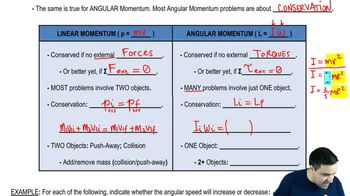
Conservation of Angular Momentum

Centripetal Force

Centripetal force is the net force required to keep an object moving in a circular path, directed towards the center of the circle. When the ball is attached to the wheel, it experiences centripetal force due to the wheel's rotation. This concept is essential for analyzing the forces acting on the ball before it is released and how they influence its subsequent motion.
Recommended video:
Guided course
06:48
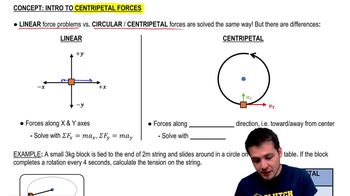
Intro to Centripetal Forces

Projectile Motion

Projectile motion refers to the motion of an object that is launched into the air and is subject to gravitational force. Once the ball is released from the wheel, it follows a parabolic trajectory influenced by its initial velocity and the height from which it is released. Understanding projectile motion is key to calculating how high the ball rises above the center of the wheel after its release.
Recommended video:
Guided course
04:44
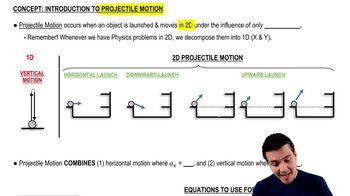
Introduction to Projectile Motion
Related Practice
Textbook Question

A computer hard disk 8.0 cm in diameter is initially at rest. A small dot is painted on the edge of the disk. The disk accelerates at 600 rad/s² for ½ s, then coasts at a steady angular velocity for another ½ s. Through how many revolutions has the disk turned?

1
views
Textbook Question

Flywheels—rapidly rotating disks—are widely used in industry for storing energy. They are spun up slowly when extra energy is available, then decelerate quickly when needed to supply a boost of energy. A 20-cm-diameter rotor made of advanced materials can spin at 100,000 rpm. What is the speed of a point on the rim of this rotor?

1
views
Textbook Question

The angular velocity of a process control motor is ω = ( 20 - ½ t² ) rad/s, where t is in seconds. At what time does the motor reverse direction?

2
views
Textbook Question

The angular velocity of a process control motor is ω = ( 20 ─ ½ t² ) rad/s, where t is in seconds. Through what angle does the motor turn between t = 0 s and the instant at which it reverses direction?

1
views
Textbook Question

A 6.0-cm-diameter gear rotates with angular velocity ω = ( 20 ─ ½ t² ) rad/s where t is in seconds. At t = 4.0 s, what are: The gear's angular acceleration?

Textbook Question

Flywheels—rapidly rotating disks—are widely used in industry for storing energy. They are spun up slowly when extra energy is available, then decelerate quickly when needed to supply a boost of energy. A 20-cm-diameter rotor made of advanced materials can spin at 100,000 rpm. b. Suppose the rotor's angular velocity decreases by 40% over 30 s as it supplies energy. What is the magnitude of the rotor's angular acceleration? Assume that the angular acceleration is constant.

2
views