
A rocket is fired from the earth to the moon at a speed of 0.990c. Let two events be 'rocket leaves earth' and 'rocket hits moon.' In the earth's reference frame, calculate ∆x, ∆t, and the spacetime interval s for these events.
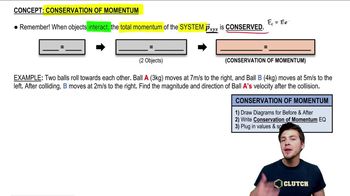
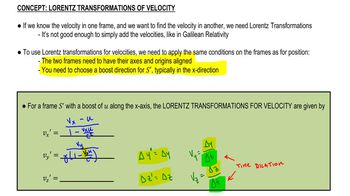
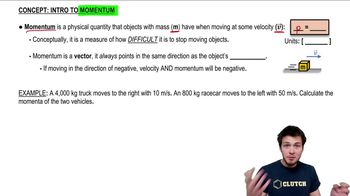
Let's examine whether or not the law of conservation of momentum is true in all reference frames if we use the Newtonian definition of momentum: px = mux. Consider an object A of mass 3m at rest in reference frame S. Object A explodes into two pieces: object B, of mass m, that is shot to the left at a speed of c/2 and object C, of mass 2m, that, to conserve momentum, is shot to the right at a speed of c/4. Suppose this explosion is observed in reference frame S' that is moving to the right at half the speed of light. Use the Lorentz velocity transformation to find the velocities and the Newtonian momenta of B and C in S'.
Verified step by step guidance
Verified video answer for a similar problem:
Key Concepts
Conservation of Momentum
Lorentz Velocity Transformation
Newtonian Definition of Momentum
The sun radiates energy at the rate 3.8 x 1026 W. The source of this energy is fusion, a nuclear reaction in which mass is transformed into energy. The mass of the sun is 2.0 x 1030 kg. Fusion takes place in the core of a star, where the temperature and pressure are highest. A star like the sun can sustain fusion until it has transformed about 0.10% of its total mass into energy, then fusion ceases and the star slowly dies. Estimate the sun's lifetime, giving your answer in billions of years.
Derive a velocity transformation equation for uy and u'y. Assume that the reference frames are in the standard orientation with motion parallel to the x- and x'-axes.
The sun radiates energy at the rate 3.8 x 1026 W. The source of this energy is fusion, a nuclear reaction in which mass is transformed into energy. The mass of the sun is 2.0 x 1030 kg. What percent is this of the sun's total mass?
A rocket is fired from the earth to the moon at a speed of 0.990c. Let two events be 'rocket leaves earth' and 'rocket hits moon.' Repeat your calculations of part a if the rocket is replaced with a laser beam.
At what speed, as a fraction of c, is the kinetic energy of a particle twice its Newtonian value?
