

Ch. 07 - Work and Energy
Giancoli Douglas - Physics for Scientists and Engineers 5th edition
Giancoli Douglas5th editionPhysics for Scientists and EngineersISBN: 9780137488179Not the one you use?Change textbook
Chapter 7, Problem 94a

A simple pendulum consists of a small object of mass m (the “bob”) suspended by a cord of length ℓ (Fig. 7–34) of negligible mass. A force F\(\overrightarrow{F}\) is applied in the horizontal direction (so F\(\overrightarrow{F}\) = Fî ), moving the bob very slowly so the acceleration is essentially zero. (Note that the magnitude of F\(\overrightarrow{F}\) will need to vary with the angle θ that the cord makes with the vertical at any moment.) Determine the work done by this force, F\(\overrightarrow{F}\), to move the pendulum from θ = 0 to θ₀.
<IMAGE>

Verified step by step guidance
1
Step 1: Understand the problem. The work done by the force F→ is equal to the change in potential energy of the pendulum bob as it is moved from θ = 0 to θ₀. Since the pendulum is moved very slowly, the kinetic energy remains negligible, and the work done is purely against gravity.
Step 2: Express the potential energy of the pendulum bob. The potential energy U at any angle θ is given by U = m * g * h, where h is the vertical height of the bob above its lowest position. Using trigonometry, h can be expressed as h = ℓ * (1 - cos(θ)), where ℓ is the length of the pendulum cord.
Step 3: Write the expression for the work done. The work done by the force F→ is equal to the change in potential energy of the bob as it moves from θ = 0 to θ₀. This can be written as W = U(θ₀) - U(0). Substituting the expression for U, we get W = m * g * ℓ * (1 - cos(θ₀)) - m * g * ℓ * (1 - cos(0)).
Step 4: Simplify the expression. Since cos(0) = 1, the term m * g * ℓ * (1 - cos(0)) simplifies to 0. Therefore, the work done is W = m * g * ℓ * (1 - cos(θ₀)).
Step 5: Finalize the result. The work done by the force F→ to move the pendulum from θ = 0 to θ₀ is W = m * g * ℓ * (1 - cos(θ₀)). This is the final expression for the work done, and it depends on the mass m, gravitational acceleration g, length of the pendulum ℓ, and the angle θ₀.

Verified video answer for a similar problem:

This video solution was recommended by our tutors as helpful for the problem above.
Video duration:
12m
Was this helpful?

Key Concepts

Here are the essential concepts you must grasp in order to answer the question correctly.

Work Done by a Force

Work is defined as the product of the force applied to an object and the displacement of that object in the direction of the force. In the context of the pendulum, the work done by the horizontal force F is calculated by integrating the force over the path taken by the bob as it moves from the vertical position (θ = 0) to an angle θ₀. The work done is dependent on the angle and the length of the pendulum.
Recommended video:
Guided course
06:09
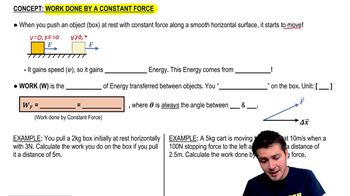
Work Done by a Constant Force

Pendulum Motion

A simple pendulum exhibits periodic motion, where the bob swings back and forth under the influence of gravity. The angle θ represents the deviation from the vertical, and as the pendulum moves, the gravitational force acting on the bob changes direction relative to the tension in the cord. Understanding the dynamics of pendulum motion is crucial for analyzing how the applied force affects the system.
Recommended video:
Guided course
07:52
Simple Harmonic Motion of Pendulums

Force Components

When a force is applied at an angle, it can be resolved into components along the coordinate axes. In this scenario, the horizontal force F must be analyzed in relation to the angle θ that the pendulum makes with the vertical. The effective component of the force that does work on the pendulum's motion must be calculated, as it varies with the angle, influencing the total work done as the pendulum moves.
Recommended video:
Guided course
07:30
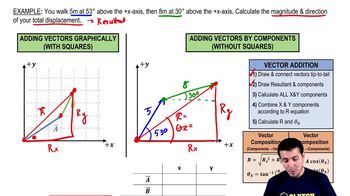
Vector Addition By Components