
Ch. 07 - Work and Energy
Giancoli Douglas - Physics for Scientists and Engineers 5th edition
Giancoli Douglas5th editionPhysics for Scientists and EngineersISBN: 9780137488179Not the one you use?Change textbook
Chapter 7, Problem 89b

A package of mass m is placed onto a horizontal conveyor belt moving at speed v (Fig. 7–32). The coefficient of kinetic friction between package and belt is μₖ. What is the package's displacement d during this time?

Verified step by step guidance
1
Identify the forces acting on the package: The forces include the gravitational force (mg), the normal force (N), and the kinetic friction force (fₖ). Since the package is on a horizontal surface, the normal force is equal in magnitude to the gravitational force, so N = mg.
Determine the kinetic friction force: The kinetic friction force is given by the formula fₖ = μₖ * N. Substituting N = mg, we get fₖ = μₖ * m * g.
Apply Newton's second law in the horizontal direction: The net force acting on the package is the frictional force, which causes the package to accelerate. Using F = ma, we have fₖ = m * a. Substituting fₖ = μₖ * m * g, we get μₖ * m * g = m * a. Simplify to find the acceleration: a = μₖ * g.
Use kinematic equations to find the displacement: The package starts from rest relative to the conveyor belt and accelerates until it matches the belt's speed v. Using the kinematic equation v = u + at, where u = 0, we solve for the time t: t = v / a. Substituting a = μₖ * g, we get t = v / (μₖ * g).
Substitute t into the displacement formula: The displacement d is given by the kinematic equation d = u * t + (1/2) * a * t². Since u = 0, this simplifies to d = (1/2) * a * t². Substituting a = μₖ * g and t = v / (μₖ * g), we get d = (1/2) * (μₖ * g) * (v / (μₖ * g))². Simplify this expression to find d in terms of v, μₖ, and g.

Verified video answer for a similar problem:

This video solution was recommended by our tutors as helpful for the problem above.
Was this helpful?

Key Concepts

Here are the essential concepts you must grasp in order to answer the question correctly.

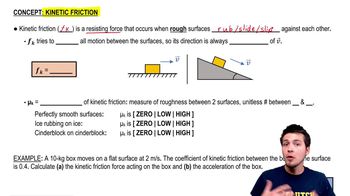
Kinetic Friction

Kinetic friction is the force that opposes the motion of two surfaces sliding past each other. It is proportional to the normal force and is calculated using the coefficient of kinetic friction (μₖ) multiplied by the normal force (N). In this scenario, it plays a crucial role in determining how the package interacts with the conveyor belt as it moves.
Recommended video:
Guided course
06:18
Kinetic Friction Problems

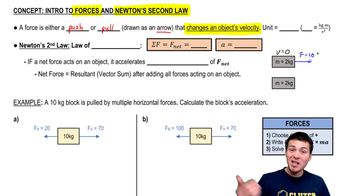
Newton's Second Law of Motion

Newton's Second Law states that the acceleration of an object is directly proportional to the net force acting on it and inversely proportional to its mass (F = ma). This principle is essential for analyzing the forces acting on the package, including the frictional force, to determine its acceleration and subsequent displacement over time.
Recommended video:
Guided course
06:54
Intro to Forces & Newton's Second Law

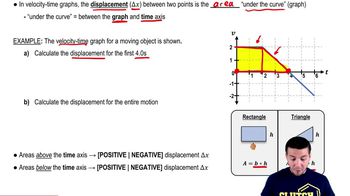
Displacement and Time Relationship

Displacement refers to the change in position of an object and can be calculated using the equation d = vt + (1/2)at², where d is displacement, v is initial velocity, a is acceleration, and t is time. Understanding this relationship is vital for solving the question, as it allows us to determine how far the package travels on the conveyor belt during the time it is in motion.
Recommended video:
Guided course
04:43
Calculating Displacement from Velocity-Time Graphs
Related Practice
Textbook Question

A simple pendulum consists of a small object of mass m (the “bob”) suspended by a cord of length ℓ (Fig. 7–34) of negligible mass. A force F\(\overrightarrow{F}\) is applied in the horizontal direction (so F\(\overrightarrow{F}\) = Fî ), moving the bob very slowly so the acceleration is essentially zero. (Note that the magnitude of F\(\overrightarrow{F}\) will need to vary with the angle θ that the cord makes with the vertical at any moment.) Determine the work done by this force, F\(\overrightarrow{F}\), to move the pendulum from θ = 0 to θ₀.

<IMAGE>

1
views
Textbook Question

A 25-g projectile is fired into a cube of ballistic gel at a velocity of 360 m/s. If the projectile penetrates 15 cm into the gel before stopping, find the average force exerted by the gel onto the projectile. Use kinematics and dynamics (Newton's laws).

1
views
Textbook Question

We usually neglect the mass of a spring if it is small compared to the mass attached to it. But in some applications, the mass of the spring must be taken into account. Consider a spring of unstretched length ℓ and mass MS uniformly distributed along the length of the spring. A mass m is attached to the end of the spring. One end of the spring is fixed and the mass m is allowed to vibrate horizontally without friction (Fig. 7–31). Each point on the spring moves with a velocity proportional to the distance from that point to the fixed end. For example, if the mass on the end moves with speed v₀, the midpoint of the spring moves with speed v₀ / 2. Show that the kinetic energy of the mass plus spring when the mass m is moving with velocity v is K = (1/2)Mv² where M = m + (1/3)MS is the “effective mass” of the system. [Hint: Let D be the total length of the stretched spring. Then the velocity of an infinitesimal length dx of spring, of mass dM, located at x is v(x) = v₀(x/D). Note also that dM = dx( MS/D).]

Textbook Question

An airplane pilot fell 370 m after jumping from an aircraft without his parachute opening. He landed in a snowbank, creating a crater 1.1 m deep, but survived with only minor injuries. Assuming the pilot’s mass was 82 kg and his terminal velocity was 45 m/s, estimate the work done by the snow in bringing him to rest.

1
views